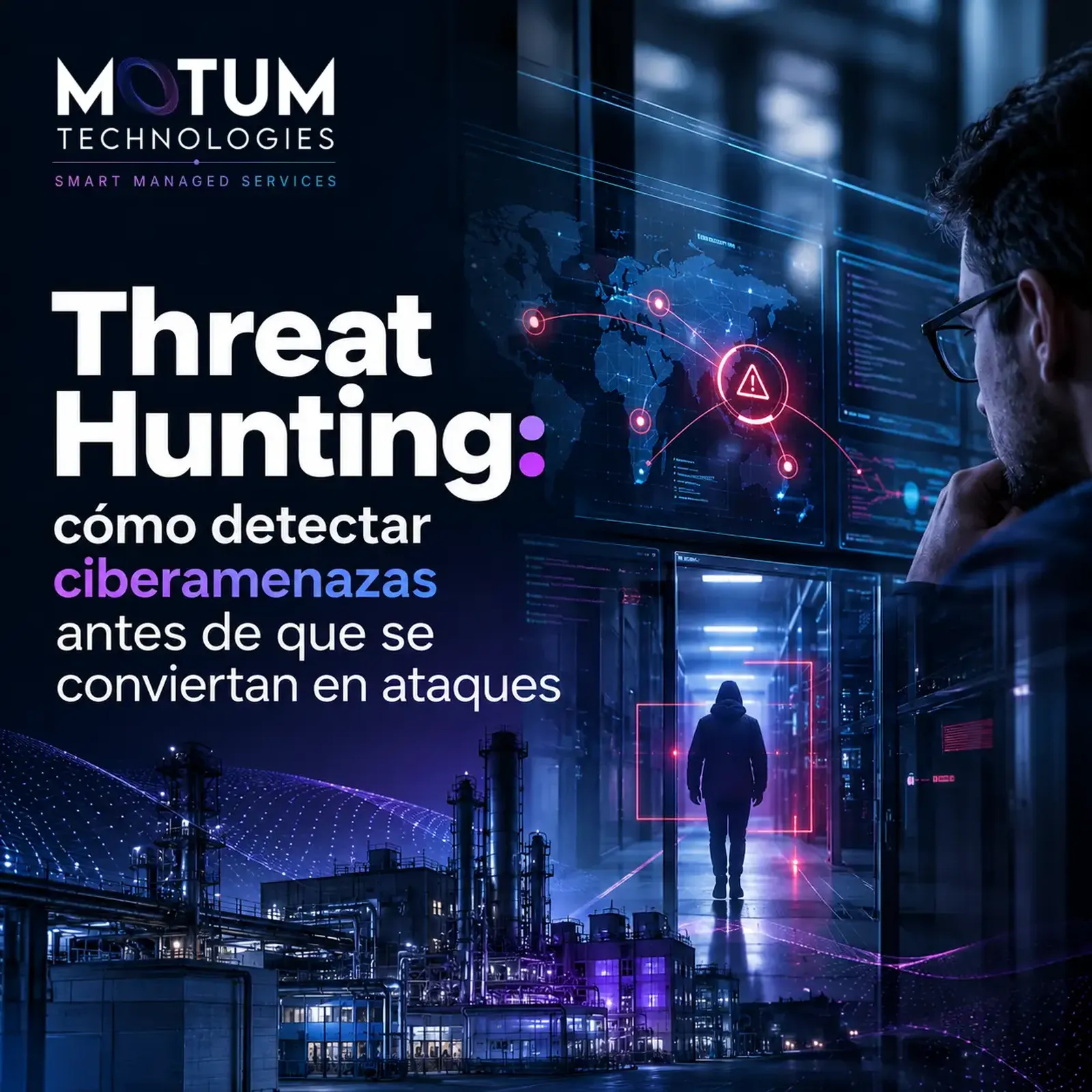

Business cybersecurity has evolved over decades around a seemingly reasonable premise: identify threats, block unauthorized access, and respond when an incident occurs. Firewalls, intrusion detection systems, endpoint protection platforms, and security operations centers have progressively refined this capability. However, there is a reality that forces a reassessment of the approach: not all threats generate an alert, and not all attackers need to use recognizable malicious tools to compromise an organization.
Sometimes the problem is not that security systems malfunction, but that certain malicious activities can be mistaken for legitimate operations. An attacker using valid credentials, leveraging administrative tools, or moving discreetly between systems can remain within an infrastructure without triggering traditional detection mechanisms.
In this context, Threat Hunting gains prominence, a proactive cybersecurity discipline that seeks to identify potentially present threats in an organization's systems, even when there are no alerts clearly indicating their presence yet.
Its importance goes beyond incorporating a new technique into the security tools catalog. It represents an evolution in the way technological risk is interpreted: moving from waiting for evidence of an attack to actively investigating if malicious activity exists that conventional controls have not identified.
For companies that depend on complex digital infrastructures, continuous operations, or connected industrial environments, this capability can make a significant difference in the early detection of compromises and the protection of their operational continuity.
What is Threat Hunting and why is it gaining importance
Threat Hunting, also known as proactive threat search, is a systematic investigation process whereby cybersecurity specialists examine networks, devices, identities, applications, and activity logs to uncover suspicious behavior that might have gone unnoticed.
Unlike automated detection mechanisms that react to previously configured rules, patterns, or models, Threat Hunting typically starts from a research hypothesis. Analysts may suspect, for example, that an attacker is using legitimate credentials to access sensitive resources or that certain movements between servers correspond to internal reconnaissance activity.
From that hypothesis, they examine the available evidence, correlate events, and look for anomalies that may confirm or rule out the existence of a threat.
This approach is especially relevant in the face of attack techniques that exploit legitimate tools of the system itself. This is known as Living off the Land, a strategy whereby cybercriminals use common functionalities of operating systems or administrative tools to execute malicious actions without necessarily introducing easily identifiable software.
The growth of hybrid environments, the multiplication of digital identities, and the convergence between information and operational technologies have significantly expanded the surface that must be investigated. An organization may have advanced protection measures and still face activities that require contextual interpretation to be identified.
Threat Hunting precisely responds to that need: incorporating human investigation, adversary knowledge, and advanced data analysis into a defense strategy that does not rely exclusively on automatic alerts.
The difference between detecting a threat and going out to look for it
To understand the value of Threat Hunting, it is useful to distinguish two complementary activities that are sometimes presented as equivalent.
Traditional detection relies on mechanisms that monitor systems and generate alerts when they identify certain behaviors. An antivirus can recognize a malicious file, an EDR platform can detect a suspicious sequence of processes, and a SIEM can correlate events from different sources to indicate a possible intrusion.
These mechanisms form a fundamental part of any modern security architecture. Their automation allows analyzing vast volumes of information and quickly responding to numerous known threats.
However, their effectiveness depends on factors such as the quality of the rules, the coverage of information sources, detection models, and the ability to contextualize events.
Threat Hunting begins where these limitations appear. Instead of waiting for an alert, the analyst poses a question: Are there indications that someone is using a privileged account in an anomalous manner? Have there been lateral connections between servers that do not correspond to usual operational patterns? Are there activities compatible with persistence techniques that have not yet been identified?
The investigation may conclude that there is no threat, but it may also uncover activity that automated systems did not consider sufficiently suspicious.
The important thing is to understand that Threat Hunting does not replace monitoring or automated detection: it complements and helps improve them. An investigation may lead to new detection rules, adjustments in security controls, or improvements in response procedures.
Thus, each search exercise can also become an opportunity to strengthen the organization's defensive capability.
How a Threat Hunting investigation works
A Threat Hunting operation is not about indiscriminately reviewing all available logs. To be effective, it needs a methodology that allows transforming large volumes of data into concrete and verifiable investigations.
The process often begins with the definition of a hypothesis based on threat intelligence, knowledge of the infrastructure, or previously observed behaviors. A company that has detected recurrent attempts to access certain accounts could investigate if any of those identities have subsequently been used from unusual locations, devices, or processes.
The next phase involves identifying relevant information sources. Authentication logs, endpoint telemetry, network communications, application events, and cloud platform data can provide pieces of the same investigation.
The difficulty lies in establishing meaningful relationships between events that, individually considered, may appear normal.
A login outside the usual hours does not necessarily prove an intrusion. Nor does a connection between two servers. But if both events coincide with the execution of certain administrative tools and subsequent accesses to sensitive information, the whole can justify a deeper investigation.
Analysts use advanced queries, correlation tools, behavior analysis techniques, and knowledge frameworks like MITRE ATT&CK to interpret the possible tactics and techniques used by an adversary.
When consistent evidence appears, the investigation may escalate to incident response teams, who will determine the necessary containment, eradication, and recovery measures.
The outcome should not be limited to confirming or dismissing a compromise. A mature practice documents the hypotheses, findings, visibility limitations, and improvement opportunities identified during the process.
The role of threat intelligence and MITRE ATT&CK
One of the characteristics distinguishing Threat Hunting from a conventional log review is its relationship with knowledge about how attackers operate.
Threat intelligence provides information on campaigns, procedures, tools, and behaviors associated with different adversaries. Its utility lies not only in having lists of malicious IP addresses or compromise indicators but in understanding what techniques could be used against a given organization.
In this sense, the MITRE ATT&CK framework has become a widely used reference for structuring investigations. Its knowledge base describes tactics and techniques observed in adversarial operations, enabling security teams to formulate hypotheses and assess their defensive coverage.
For example, an investigation may focus on possible persistence mechanisms, credential abuse, internal system discovery, or lateral movements. Each of these activities can be related to documented techniques and telemetry sources that allow searching for evidence.
This approach brings coherence to analysts' work and facilitates comparison between investigations.
It also helps to reduce an over-reliance on traditional compromise indicators. An IP address may change, and a malicious file may be modified, whereas certain operational techniques may remain relatively stable across different campaigns.
For organizations, the consequence is significant: knowing the adversary's techniques allows for better investment guidance in visibility, detection, and response.
Threat Hunting and SOC: two capabilities that must work together
Security Operations Centers, known as SOCs, play an essential role in monitoring and managing incidents. Their daily activities include event monitoring, alert analysis, threat classification, and response coordination.
Threat Hunting adds an investigative dimension to this model.
While a significant part of a SOC's operational activity responds to events identified by its systems, proactive search exercises allow investigating scenarios that have not yet produced a sufficiently clear alert.
This integration is particularly interesting in organizations using managed cybersecurity services. Having specialists capable of interpreting complex behaviors, leveraging threat intelligence, and turning investigation results into detection improvements can expand the protection capacity of internal teams.
However, it is important to distinguish between hiring a monitoring service and truly having Threat Hunting capabilities. Proactive search requires research time, specialized profiles, access to sufficiently detailed information, and defined procedures.
A technological platform, no matter how advanced, does not alone ensure the existence of this capability.
Therefore, when a company evaluates managed security services, it is advisable to know how investigations are carried out, what coverage they offer, how often they are developed, and how their conclusions are incorporated into protection mechanisms.
The value of the model lies in the integration between technology, specialized knowledge, and operational processes.
The importance of Threat Hunting in IT and OT environments
In industrial infrastructures, proactive threat analysis acquires particular characteristics. The convergence between IT systems and operational technologies has multiplied the possibilities of information exchange, remote monitoring, and process optimization, but it has also introduced new security dependencies.
A pharmaceutical installation, a production plant, or an energy infrastructure can integrate corporate systems, monitoring platforms, industrial networks, engineering stations, and connected devices with different levels of criticality.
In these scenarios, suspicious activity should not be evaluated solely from the perspective of information confidentiality. Its potential consequences on availability, process integrity, and operational security must also be considered.
Threat Hunting applied to OT environments requires understanding the usual behaviors of industrial systems and the technical limitations of the equipment. Certain analysis tools used in corporate networks may be unsuitable for sensitive devices or infrastructures that do not allow interruptions.
For this reason, investigations often require special attention to passive telemetry, available logs, segment communications, and remote access.
Coordination between cybersecurity, infrastructure, and operations managers is crucial to correctly interpret findings.
An unexpected connection to an engineering station, for example, may respond to authorized maintenance or represent an activity worthy of investigation. Distinguishing between these situations requires technical knowledge, operational context, and shared procedures.
For companies with distributed operations or critical facilities, integrating this perspective into the management of their IT/OT infrastructures allows progress towards security more adapted to their real needs.
Artificial intelligence and advanced analysis: new capabilities, new limits
Artificial intelligence is expanding the possibilities of cybersecurity analysis, especially in environments where large amounts of information are generated.
Machine learning models can help identify deviations from usual patterns, group related events, and prioritize investigations. Tools based on language models can also facilitate certain tasks of query, documentation, and assisted analysis.
These capabilities can reduce some repetitive work and allow specialists to spend more time interpreting complex evidence.
However, the incorporation of AI does not eliminate the fundamental difficulties of Threat Hunting.
Models can generate false positives, misinterpret certain behaviors, or overlook activities that do not fit their learning patterns. Additionally, a statistical anomaly does not necessarily equate to a threat.
The quality of data remains decisive. If an organization lacks visibility over certain devices, identities, or network segments, no artificial intelligence tool will be able to accurately reconstruct all the activity that has not been recorded.
It is also necessary to establish controls over the information used, the traceability of analyses, and the oversight of decisions.
The most promising combination is not to replace analysts with algorithms, but to provide them with better tools to investigate, test hypotheses, and recognize relevant behaviors.
In short, automation can speed up the search, but expert judgment is still indispensable to understand what the findings mean within the context of each organization.
What a company needs to incorporate Threat Hunting into its strategy
The implementation of Threat Hunting capabilities should not necessarily begin with the acquisition of a new platform. It is advisable first to assess whether the organization has sufficient information to investigate its own infrastructure.
Visibility is the primary requirement. Security teams need to know what assets exist, how they communicate, what identities have access to them, and what events can be reconstructed using available records.
It is also important to have a monitoring architecture capable of correlating information from different sources. Technologies like EDR, NDR, SIEM, or XDR platforms can contribute to this goal, provided their configuration and coverage correspond to the actual risks of the environment.
The second element is specialized knowledge. Formulating useful hypotheses requires understanding attackers' techniques, but also business processes, infrastructure peculiarities, and the normal behaviors of users and systems.
Finally, there must be a clear connection between investigation and response. Detecting a possible threat has limited value if the organization lacks procedures to verify, contain, and correct the identified weaknesses.
Not all companies need to fully develop these capabilities with their own resources. Managed services models allow the combination of the organization's internal knowledge with external specialists, monitoring tools, and security procedures tailored to their needs.
The decision should respond to the level of exposure, the criticality of assets, and the available operational capacity, avoiding the adoption of oversized or hard-to-maintain solutions.
How to measure the real value of Threat Hunting
One of the challenges of proactive threat hunting is demonstrating its contribution to business security.
Unlike other technological activities, its success cannot be measured solely by the number of incidents detected. An investigation that does not discover malicious activity can provide useful information about system coverage, although it does not demonstrate that the infrastructure is completely protected.
Therefore, it is more appropriate to use indicators that allow evaluating the maturity and effectiveness of the process.
Among them, the coverage of investigated techniques, the availability of telemetry sources, the time needed to validate a hypothesis, and the number of detection improvements derived from the investigations stand out.
The capacity to identify activities that had not generated previous alerts and the speed with which findings are translated into protective measures can also be analyzed.
These indicators help turn Threat Hunting into a process of continuous improvement, rather than an isolated activity.
From the business perspective, its contribution should be interpreted within a broader strategy of technological risk management. The early detection of an intrusion can facilitate its containment before more serious consequences occur, although it is not possible to guarantee that all attacks will be discovered in time.
The goal is not to promise absolute security, but to progressively improve the organization's capacity for anticipation, investigation, and response.
From technological protection to operational resilience: the vision of Motum Technologies
The evolution of threats is transforming the expectations that companies place on their technology providers. It is no longer enough to keep systems available or to incorporate security solutions independently. Organizations need to understand how their infrastructures relate, what dependencies affect their operations, and how they can reduce their exposure to incidents.
In Motum Technologies, this perspective connects with a proposal for integrated technological services that combines Smart Managed Services, IT/OT infrastructure management, connectivity, cybersecurity, and software solution development.
Proactive threat hunting fits into this approach as a capability that must be supported by well-managed infrastructure, adequate monitoring, and coordinated security procedures. It is not about considering Threat Hunting as an isolated tool, but understanding what technical and organizational conditions allow for effective utilization.
For industrial companies, organizations with multiple locations or businesses that rely on continuous digital services, coordination between operations and security becomes especially important. A technological incident can affect different areas of the business, so its prevention and management require a cross-sectional vision.
Experience in IT/OT environments and managed services allows addressing these needs from the knowledge of the infrastructure and its operational demands, identifying opportunities to strengthen visibility, protection, and response capability.
Threat Hunting ultimately represents an evolution in cybersecurity culture: accepting that preventive controls can be bypassed and that investigating what has not yet triggered an alarm is part of mature defense.
Because in an increasingly interconnected technological environment, security does not only depend on detecting what we know is dangerous, but also on learning to recognize what we have not yet managed to identify.
Frequently asked questions
Sources & further reading
attack.mitre.org ↗MITRE ATT&CK — Enterprise Matrix
microsoft.com ↗Microsoft Security — What Is Cyber Threat Hunting?Cyber threat hunting is the process of proactively searching for, preventing, and remediating unknown, undetected threats within an organization’s network.
 CrowdStrike.com ↗CrowdStrike — What Is Cyber Threat Hunting?Cyber threat hunters dig deep into a network to find malicious actors in an environment that have slipped past initial endpoint security defenses.
 cisa.gov ↗CISA — Identifying and Mitigating Living Off the Land TechniquesCybersecurity and Infrastructure Security Agency: America's Cyber Defense Agency
 Google Cloud ↗Google Cloud — What Is Threat Hunting?Threat hunting helps detect cyber threats before they strike. Learn what it is, how it works, and why it’s essential for modern cybersecurity.
 Motum Technologies ↗The 10 most common mistakes in OT cybersecurityDescubra los 10 errores más frecuentes en ciberseguridad OT que ponen en riesgo la continuidad industrial y cómo prevenirlos con una estrategia IT/OT eficaz.
 Motum Technologies ↗What is NIS2 and who does it really affectQué es NIS2, a qué empresas afecta y cómo preparar la ciberseguridad IT/OT, la gestión de proveedores y la continuidad de las operaciones de tu negocio.
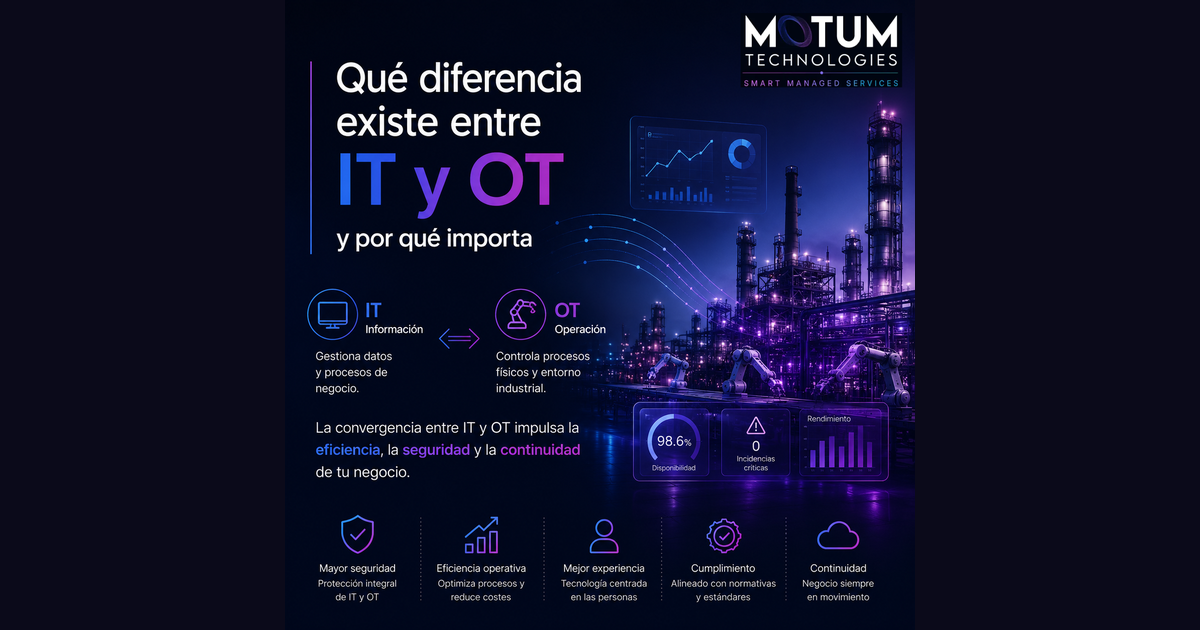 Motum Technologies ↗What is the difference between IT and OT and why does it matterDescubre qué diferencia existe entre IT y OT, por qué su convergencia es clave para la Industria 4.0 y cómo mejorar la seguridad, eficiencia y continuidad de los entornos críticos.
qué es IT
qué es OT
Operational Technology
Information Technology
convergencia IT OT
integración IT OT
Industria 4.0
ciberseguridad OT
infraestructura IT
infraestructura OT
Smart Managed Services
infraestructuras críticas
automatización industrial
transformación digital industrial
monitorización industrial
continuidad del negocio
IIoT
sistemas SCADA
PLC industrial
OT Security
IT
OT
Operational Technology
Information Technology
IT/OT Convergence
Industria 4.0
Industrial Internet of Things
IIoT
SCADA
PLC
Infraestructuras críticas
Ciberseguridad Industrial
Smart Managed Services
Continuidad Operativa
Edge Computing
Data Lake
Monitorización
Digitalización Industrial
Motum Technologies
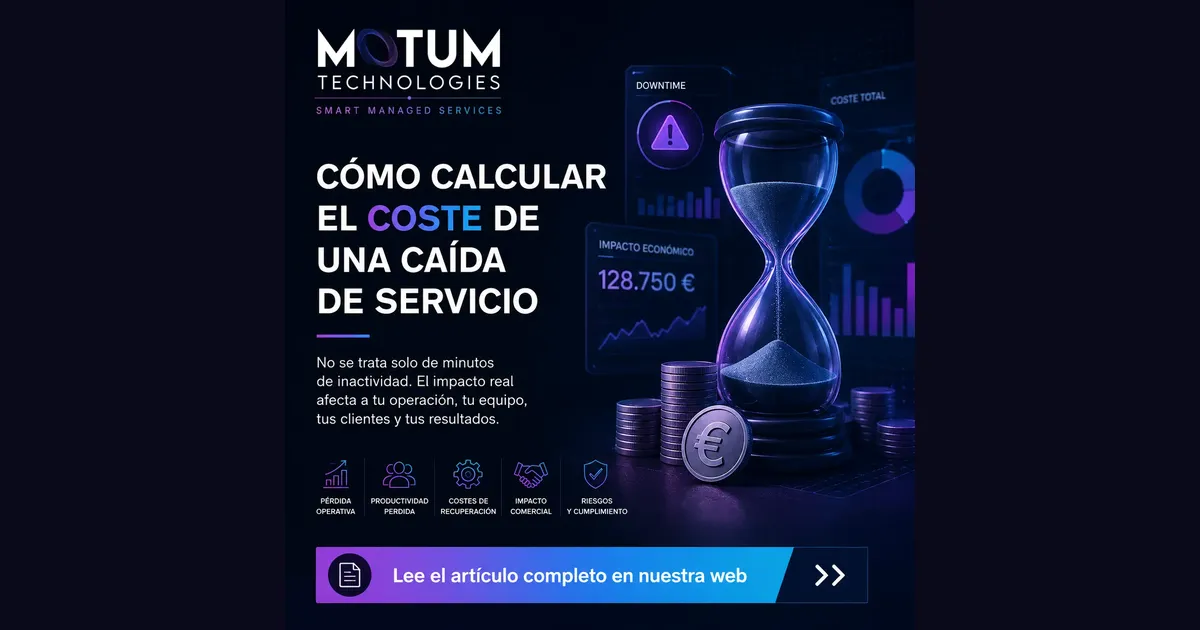 Motum Technologies ↗How to calculate the cost of a service outage Aprende a calcular el coste real de una caída de servicio, desde productividad y operación hasta recuperación, ventas y continuidad de negocio.
 Motum Technologies ↗AI Governance: 5-pillar framework for enterprisesEl conocimiento que impulsa el Movimiento Infinito. Análisis, tendencias y experiencias sobre ciberseguridad, IT/OT, infraestructuras, conectividad e innovación tecnológica para organizaciones que no pueden detenerse.
 Motum Technologies ↗Managed IT/OT Services — Motum TechnologiesServicios gestionados IT/OT desde Barcelona, con monitorización 24x7, ciberseguridad y soporte experto para dar continuidad a tus operaciones críticas.