For years, cybersecurity was seen as a purely technological matter. A problem for the IT department. Something to be solved with antivirus software, firewalls or backups.
That paradigm has changed completely.
Digital transformation, hyperconnectivity and the rise in targeted attacks on critical infrastructure have turned cybersecurity into a strategic issue that directly affects business continuity. This is the context in which the NIS2 Directive was born, a European regulation that represents one of the biggest regulatory changes in digital security in decades.
Yet many companies still think it is a regulation aimed only at large energy or telecoms operators. The reality is quite different.
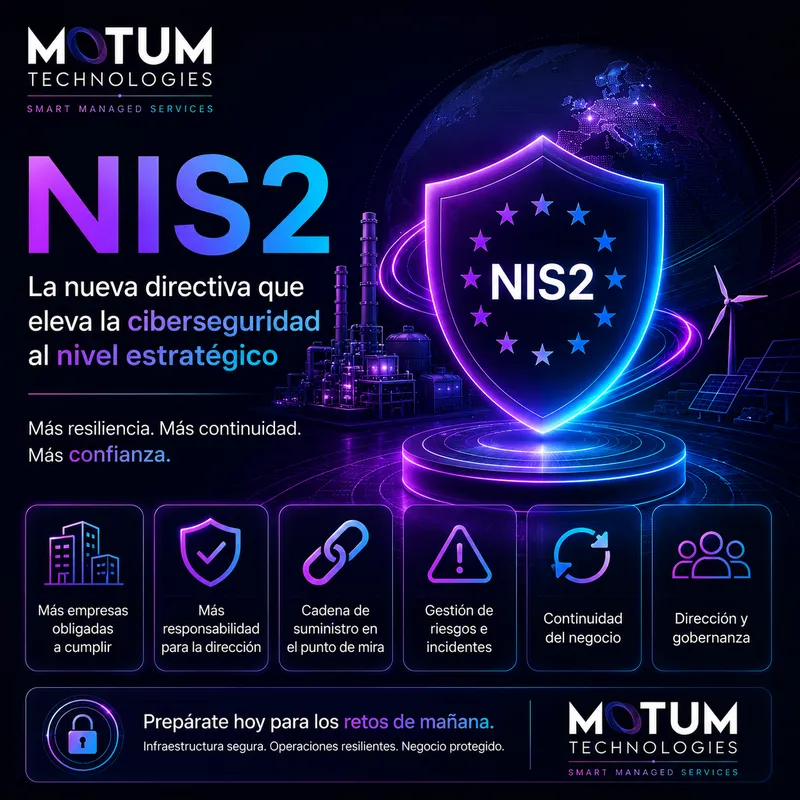
NIS2 greatly expands the number of organisations required to adopt cybersecurity measures and raises the level of responsibility for both management and the entire supply chain.
The question is no longer whether a company should prepare.
The question is whether it can really afford not to.
What exactly is the NIS2 Directive?
The NIS2 Directive (Network and Information Security Directive 2) is the evolution of the first European regulation on the security of network and information systems, approved in 2016.
Its aim is to strengthen the digital resilience of the whole European Union in the face of a growing number of cyber threats.
But NIS2 does not only seek to protect computer systems. Its purpose is to ensure that organisations capable of affecting the functioning of the economy or essential services maintain minimum levels of security, response capability and operational continuity.
The new directive introduces much stricter obligations in areas such as:
Risk management.
Cybersecurity governance.
Protection of critical infrastructure.
Incident management.
Supply chain security.
Business continuity.
Management training.
Regular audits.
In other words, cybersecurity stops being a technical problem and becomes a corporate responsibility.
Why was a new regulation needed?
Since the first NIS was approved, the landscape has changed radically.
Ransomware attacks have multiplied their financial impact.
Industrial OT systems are increasingly connected.
Technology suppliers have access to critical infrastructure.
Digital supply chains are more complex than ever.
And the consequences of a breach no longer affect just one company; they can paralyse entire sectors.
The attacks suffered by hospitals, energy operators, ports, public administrations and industrial manufacturers in recent years have shown that a single vulnerability can have national consequences.
Europe is responding with a much more demanding approach.
Who does NIS2 really affect?
This is probably the biggest difference compared with the previous regulation.
NIS2 considerably expands the number of organisations required to comply.
We are no longer talking only about large critical operators.
It also affects medium-sized companies and even many private organisations that are part of strategic supply chains.
The sectors included are industry and manufacturing, energy, transport, health, food, water, waste management, public administration, digital services, telecommunications, cloud infrastructure, data centres, financial services and more.
But there is another especially relevant aspect.
Many companies that will not be directly bound will still have to meet security requirements because their customers will be subject to NIS2.
As a result, large organisations are demanding new cybersecurity guarantees from all their suppliers.
Security stops being a competitive advantage and becomes a requirement for access to the market.
The supply chain comes under the spotlight
One of the major changes introduced by NIS2 is the importance given to supplier management.
Every company is only as secure as the weakest link in its supply chain.
Recent attacks have shown that it is much easier to compromise a small supplier than to break directly into a large multinational.
That is why the directive requires organisations to assess the risks associated with third parties.
This means reviewing outsourced technology services, cloud platforms, software development, remote maintenance, managed services, technology integrators, OT suppliers and support companies.
Risk management is no longer limited to an organisation's own infrastructure.
It now covers the entire technology ecosystem.
What does NIS2 actually require?
Although each country adapts the regulation to its national legislation, the general approach is very clear.
Organisations must show that they actively manage their cybersecurity risks.
Having tools is not enough.
Processes have to be put in place.
The main obligations include:
Regular risk assessments.
Documented policies.
Vulnerability management.
Business continuity plans.
Incident response.
Verified backups.
Access control.
Identity management.
Staff training.
Continuous monitoring.
Mandatory reporting of significant incidents.
The philosophy changes completely.
The organisation must be able to show that it governs security on an ongoing basis.
Responsibility reaches all the way to management
One of the most significant aspects of NIS2 is that it no longer treats cybersecurity as a purely technical matter.
Senior management becomes responsible for overseeing the security strategy.
Governing bodies must understand digital risks, approve policies, allocate resources and make sure the organisation maintains an adequate level of protection.
This turns cybersecurity into a question of corporate governance.
It is not just a technology project.
It is a business decision.
What role does the OT environment play?
In industrial, energy, logistics or infrastructure sectors, much of the risk lies outside the traditional IT department.
OT networks control physical processes, machinery, production lines and automation systems.
For years these environments remained isolated.
Today they are connected through IoT solutions, cloud platforms, remote monitoring and predictive maintenance systems.
This greatly increases the attack surface.
That is why NIS2 pays special attention to the integration of IT and OT.
Protecting corporate servers is not enough.
The systems that keep industrial activity running must also be protected.
How can a company prepare?
Many organisations think that adapting to NIS2 simply means carrying out an audit.
In reality, the process usually starts much earlier.
The first step is to understand the real state of the organisation.
Next, you need to identify critical assets, assess risks, review suppliers and define a prioritised roadmap.
The most mature companies tend to rely on specialised services that can combine different disciplines such as cybersecurity, network infrastructure, monitoring, managed services, business continuity, software development and technology governance.
This approach reduces risk without turning compliance into an administrative burden.
The importance of Smart Managed Services
Most organisations do not have the resources to keep specialised teams continuously monitoring hybrid infrastructure, industrial networks, cloud platforms and critical systems.
This is where Smart Managed Services become especially relevant.
Beyond traditional support, this model makes it possible to monitor infrastructure continuously, detect incidents, automate processes, maintain high availability and ensure constant improvement of the technology environment.
It also makes it easier to meet regulatory requirements such as NIS2, as it brings procedures, monitoring, traceability and response capabilities that many organisations could not maintain efficiently in-house.
NIS2 also changes the way technology is bought
Another less visible but equally important aspect is its impact on technology procurement processes.
Buying technology can no longer be based solely on price.
Organisations will also have to assess aspects such as:
The supplier's level of cybersecurity.
Certifications.
Continuity guarantees.
Response capability.
Vulnerability management.
Support.
Product life cycle.
Risk of technology dependency.
In this context, digital procurement takes on a much more strategic role.
Choosing the right technology suppliers becomes part of the risk management strategy itself.
Beyond regulatory compliance
Reducing NIS2 to a legal obligation would be a mistake.
Companies that use this opportunity to strengthen their infrastructure will gain much broader benefits:
Greater resilience.
Greater trust from customers and partners.
Lower exposure to cyberattacks.
More efficient processes.
Better technology governance.
Greater operational continuity.
And a much more competitive position in markets where security is becoming an essential requirement for doing business.
Conclusion
NIS2 represents a profound change in the way business cybersecurity is understood.
Protecting computer systems is no longer enough. The ability to operate must be protected.
Organisations that take a comprehensive view, combining infrastructure, security, IT/OT operations, business continuity and intelligent supplier management, will be much better prepared for an environment where digital risks are part of everyday life.
In this context, having a technology partner able to design, deploy and manage secure infrastructure, monitor critical environments and support the organisation through its regulatory adaptation makes a significant difference. At MOTUM Technologies we help companies in the industrial, energy, healthcare, logistics and services sectors move towards Smart Managed Services models, integrating cybersecurity, IT/OT operations, connectivity, software development and technology procurement to guarantee business continuity and face challenges such as the NIS2 Directive with confidence.
Frequently asked questions (FAQ)
What does NIS2 mean?
NIS2 is the second European Directive on the security of network and information systems. Its aim is to improve the cybersecurity and resilience of essential and important organisations against increasingly sophisticated digital threats.
Which companies must comply with NIS2?
The regulation affects organisations in sectors such as industry, energy, transport, health, public administration, telecommunications, digital services, water, food, cloud infrastructure and data centres, among others. It can also indirectly affect suppliers that work with these entities.
Does NIS2 affect SMEs?
Yes. Many medium-sized companies will be directly included because of their size or activity, while others will have to adapt because they are part of the supply chain of companies required to comply.
What happens if a company does not comply with NIS2?
Depending on national legislation, financial penalties, corrective measures and liability for management bodies may be imposed. Non-compliance can also make it harder to win contracts with customers that require cybersecurity guarantees.
How are NIS2 and OT cybersecurity related?
The directive places special focus on protecting industrial environments and OT systems, where an incident can directly affect production, physical safety or service continuity.
How does a managed service help with NIS2 compliance?
Smart Managed Services make it possible to monitor infrastructure, detect threats, manage incidents, keep systems available and document processes, making it easier to meet many of the technical and organisational requirements of the regulation.
What role does digital procurement play in NIS2?
Digital procurement stops focusing only on price and starts weighing factors such as the supplier's security, service continuity, support, certifications and technology risk management. Choosing the right suppliers is now an essential part of any organisation's cybersecurity strategy.
How can a company start preparing for NIS2?
The first step is to assess the organisation's current state, identify critical assets, analyse technology risks and define an improvement plan. Working with a partner specialising in infrastructure, cybersecurity, IT/OT and managed services makes this process easier and allows the adaptation to be tackled progressively and efficiently.