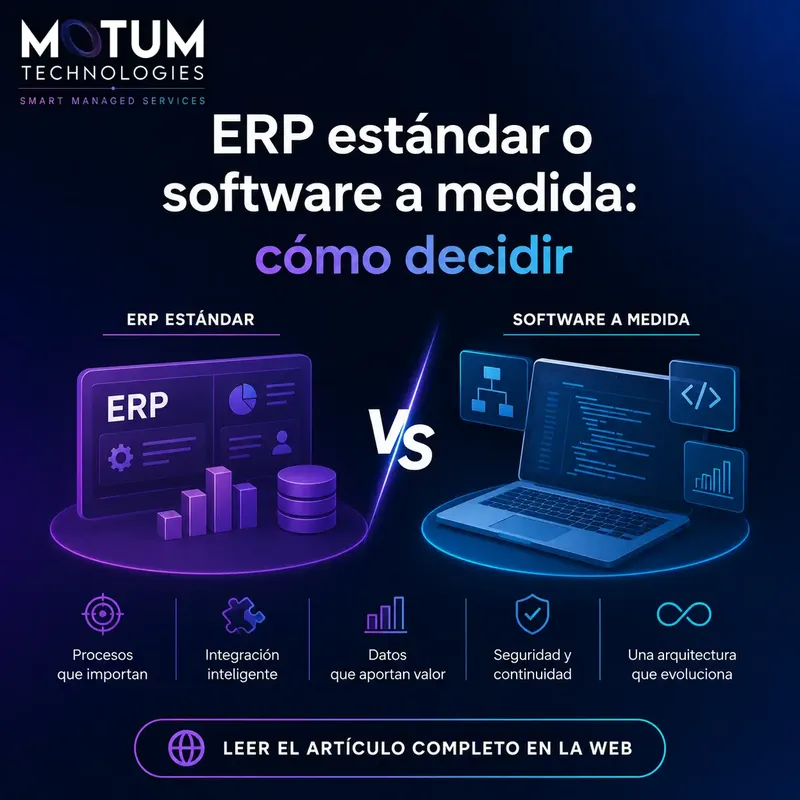
Some technology decisions seem technical until they start to affect the way the whole company works. Choosing between implementing a standard ERP and developing custom software is one of them.
On paper, the comparison looks simple. An ERP offers a consolidated platform, predefined processes and a proven technology ecosystem. Custom software makes it possible to build exactly what the organisation needs. From there, it would be tempting to reduce the decision to a question of budget, implementation time or number of features.
In practice, the problem is far more complex.
The really important question is not whether a standard ERP is better or worse than an in-house development. The question is to what extent the company should adapt its processes to the software, and to what extent the software should adapt to its processes.
The answer depends on how the business works, which processes really create a competitive advantage, how much integration with other systems is needed and how much the organisation is expected to change over the coming years.
That is why, before comparing suppliers, features or budgets, it is worth understanding what is really being decided.
ERP was born to solve a very specific problem
ERP (Enterprise Resource Planning) systems have become a central part of the technology architecture of thousands of organisations. Finance, purchasing, sales, inventory, human resources, production and logistics can be managed from a single platform, so that each department does not operate with completely independent systems.
Its main strength lies precisely in standardisation.
A good ERP incorporates processes that have been tested in many organisations and provides a common structure on which to manage much of the company's activity. For many companies, especially when it comes to relatively conventional administrative processes, this is a huge advantage.
It makes little sense to develop an accounting, invoicing or basic supplier management system from scratch if there are mature platforms able to meet those needs reliably.
In addition, adopting an ERP can force a review of procedures that have been kept for years simply because "that's how it has always been done". Sometimes the supposed uniqueness of a process is not a competitive advantage but a historical build-up of exceptions.
Standardisation can be healthy.
The problem appears when that logic is applied indiscriminately to the whole organisation.
Not all of a company's processes have the same value
Two companies in the same sector can use the same ERP and yet compete in completely different ways. The difference is usually found in what happens around the standard processes.
It may be the way they plan production. The way they configure a product. The system they use to calculate certain quotes. How they manage traceability. How they coordinate field technicians. How they integrate information from industrial machinery. How they prioritise orders or how they turn operational data into decisions.
That is where the real limit of standard software starts to appear.
When a process is an important part of an organisation's know-how, forcing it to fit into a generic tool can end up eliminating precisely what made the company different.
The question, therefore, should not be "can we do this with the ERP?" but "does it make sense for us to do this the way the ERP proposes?".
The difference looks small, but it completely changes the conversation.
The invisible cost of adapting the company to the software
During an implementation it is common to discover that certain internal procedures do not exactly fit the logic of the chosen platform. Two options then appear: change the process or customise the ERP.
Changing the process can be an excellent decision for administrative activities with no differentiating value. However, it can be a far more debatable decision when it affects operations that contain business-specific know-how.
The other alternative is to gradually customise the platform.
At first it seems a reasonable solution. A form is changed, a particular rule is added, an additional module is developed or an integration is created. The problem arises when the exceptions start to pile up.
After a few years, some organisations discover that what they bought as standard software has become a deeply customised version that is hard to update, maintain and integrate.
It is a fairly common paradox: an ERP is chosen to avoid developing software, and the company ends up maintaining a huge amount of development inside the ERP itself.
At that point, the standard-versus-custom discussion takes on a different dimension.
Custom software is not the answer to everything either
The opposite mistake is to think that, because custom software offers more flexibility, it should be used to meet every need.
Developing custom software makes sense when there is a business reason to do so.
Every in-house application brings responsibilities. Its architecture has to be defined, the code developed, tests carried out, and it has to be secured, documented, monitored and evolved. It must also be integrated with the rest of the technology ecosystem and kept compatible with the business's new needs.
An application does not end the day it goes into production.
In fact, that is the day its working life begins.
That is why developing from scratch features that are perfectly covered by standard solutions is usually a poor use of resources. The value of custom development appears when it solves something the market does not solve adequately, or when it gives the organisation a capability of strategic importance.
The key is knowing how to tell the two situations apart.
A useful question: does this process set us apart?
There is a fairly simple way to start structuring the decision.
Imagine two broad categories of processes.
In the first are the activities any company needs in order to function: accounting, tax management, basic administration, certain human resources functions or relatively standardised financial processes. With few exceptions, a company's competitive advantage is unlikely to come from having developed its own accounting system.
Here standard software usually makes a lot of sense.
In the second category are processes closely tied to how the organisation creates value: production, specialised logistics, customer relationships, product configuration, industrial operations, maintenance, traceability, data exploitation or certain commercial decisions.
The more specific and differentiating the process, the more reasonable it is to look at a custom solution.
This does not necessarily mean replacing the ERP.
It means no longer assuming that the ERP has to do everything.
Hybrid architecture: probably the most interesting conversation
For years, many technology decisions were framed as a binary choice: buy or build.
Today that boundary is much less rigid.
An organisation can keep an ERP as its transactional core and build specific applications around it. It can use a standard platform for finance and purchasing while developing its own tools for operations, production or customer relationships. It can add specialised cloud services, mobile applications, data platforms and industrial systems connected through APIs.
This hybrid architecture makes it possible to benefit from the maturity of standard software without giving up on developing differentiating capabilities.
The ERP then no longer has to be "the system that does everything" and becomes a fundamental piece within a larger ecosystem.
The conceptual shift is important.
Instead of trying to fit every process into a single application, an architecture is designed in which each component does what it is best suited for.
Naturally, this introduces a new requirement: integration.
The real challenge often lies between the applications
A company can have an excellent ERP, an advanced CRM, specialised industrial applications and custom-built tools, and still suffer huge inefficiencies.
The problem appears when those systems do not communicate properly.
Data that has to be entered twice. Spreadsheets used to move information between departments. Manual exports. Applications holding different versions of the same data. Processes that start digitally, go through an email and end up back inside another platform.
The quality of a technology architecture does not depend only on the individual quality of its applications.
It depends on how they work together.
That is why, when evaluating an ERP or a custom development, integration capability should be central. APIs, data models, identity systems, information exchange mechanisms and connectivity with existing applications can be more decisive in the long run than some of the features that usually dominate sales demos.
In industrial environments this becomes even more relevant, because information can also come from OT systems, machinery, sensors, supervision platforms or distributed facilities.
The architecture must connect worlds that have historically evolved separately.
Data should also be part of the decision
There is another question that does not always get enough attention when selecting software: what will we be able to do tomorrow with the data this system generates?
For years, many business applications were designed mainly to record transactions. Today organisations need more. They need to combine information, analyse it, automate decisions and feed analytical models or artificial intelligence applications.
That requires thinking about data from the start.
A solution can meet a functional need perfectly and yet make it extremely difficult to extract or integrate information later. Another may have excellent interoperability capabilities that make it easier to build dashboards, predictive models, automations or new digital services.
Choosing technology only for what it lets you do today can be too narrow a view.
What it will let you build tomorrow also matters.
Security and continuity: two criteria that should not come last
When an application becomes part of day-to-day operations, it is no longer just software. It becomes business infrastructure.
This means its availability, protection and recoverability must be assessed from the design stage.
Authentication, permissions, traceability, updates, backups, incident recovery, monitoring, vulnerabilities and regulatory compliance should not be added once the project is finished.
They are part of the architecture.
This perspective is especially important in organisations where IT and OT environments coexist, or where a technology interruption can affect production, logistics, customer service or essential services.
The best feature quickly loses its value when the system that provides it is unavailable.
Cost cannot be analysed only as an upfront investment either
One of the most common mistakes in this type of decision is comparing the price of ERP licences with the initial budget for a custom development.
These figures represent different things.
To evaluate the alternatives properly, you need to look at the total cost over several years: licences, implementation, infrastructure, integrations, customisations, maintenance, support, updates and functional evolution.
For custom software you must also consider development, corrective and evolutionary maintenance, infrastructure, security, monitoring and technical know-how.
But there is another dimension that is harder to capture in a spreadsheet: the cost of friction.
How much time does the organisation spend adapting its operations to the system? How many manual tasks survive around the platform? How many automation opportunities are lost? What happens when the business needs to launch a new service and the technology architecture takes months to adapt?
Technology cost is not only what appears on the supplier's invoice.
It is also what the technology prevents you from doing.
How to make the decision without starting with the technology
The best selection usually starts before looking at products.
First you have to understand the process.
Who takes part. What information they use. What decisions they make. What exceptions exist. What other systems are involved. What happens when something fails. What data is generated and where it should end up.
Then it is worth separating what is standard from what is differentiating.
Only then does it make sense to analyse whether the need should be met with an ERP, a specialised application, custom development or a combination of several alternatives.
This way of working avoids one of the most common problems in technology projects: falling in love with a solution before having understood the problem well enough.
An example: an industrial company with several plants
Consider an industrial company with several production sites.
It may be perfectly reasonable to use a standard ERP to manage finance, purchasing, inventory and certain administrative operations. However, the reality on the plant floor may include much more specific processes: automatic data capture, material traceability, control of certain operations, integration with machinery, maintenance, incident management or dashboards tailored to each site.
Trying to fit all of that into the ERP can lead to considerable customisation.
The alternative could be to keep the ERP as the central system and develop a specific layer for industrial operations, connected both to the ERP and to the OT systems.
The data collected could be transformed and centralised to feed analytics tools, automations or business applications.
In this scenario, the debate is no longer ERP or custom software.
The question becomes how to design an architecture able to make good use of both.
The role of the technology partner changes when the question changes
This approach requires a broader view than simply implementing a tool.
At Motum Technologies we approach software development from that perspective: first understanding the operation, then building the technology architecture that best fits it.
That may mean developing a complete application, creating an integration, building a data exploitation layer or connecting business systems with existing IT and OT infrastructure. Motum works both on turnkey projects and through development-as-a-service teams, using scalable, secure architectures ready to integrate through APIs.
But software is only part of the equation.
When an application becomes critical, it also needs infrastructure, connectivity, monitoring, cybersecurity and operational capability. Motum's Smart Managed Services model brings these disciplines together precisely to manage and protect technology environments continuously, including IT/OT infrastructure, networks, and 24x7 support and operations.
The advantage of this view is that it makes it possible to think about the whole life cycle of the solution, not just its initial development.
The best architecture is the one that lets you change
The most important criterion for choosing between a standard ERP and custom software is probably also the hardest to measure.
The ability to evolve.
Processes will change. New needs will arise. There will be acquisitions, new plants, new channels, new regulatory requirements and technologies that are not yet part of today's conversation.
An architecture that is too rigid can turn every change into a complex project. An overly customised architecture can create a maintenance burden that is hard to sustain.
The balance lies in standardising what does not set you apart and keeping flexibility where the company needs to evolve.
That is why the answer to the question "standard ERP or custom software" should rarely be ideological.
There are processes for which buying is clearly better than building. There are others where developing an in-house capability can become a strategic investment. And there is an ever-wider territory where both alternatives must coexist.
The real decision is not about choosing between standard and custom.
It is about knowing what deserves to be standard and where it is worth being different.