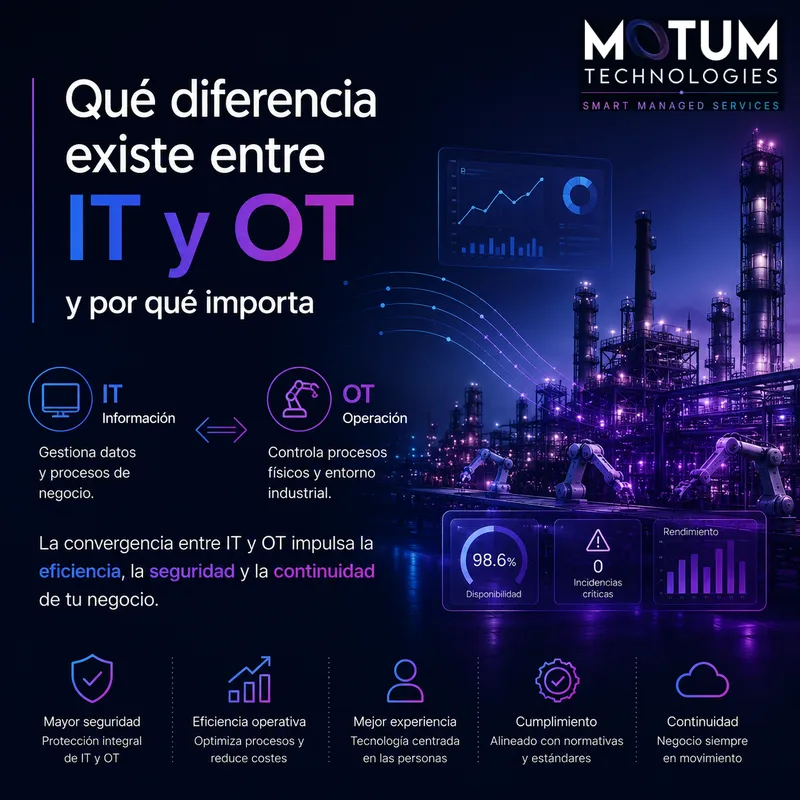
Talking about technology in a company often means talking about computers, servers, corporate networks, management applications or email. In short, everything that lets information flow within the organisation. That world is called IT (Information Technology) and it is still the backbone of practically any company's digital transformation.
However, there is another technology that is much less visible to anyone working outside an industrial plant, a hospital or a critical infrastructure, but just as important or even more so. It is Operational Technology, known as OT (Operational Technology), and it is what keeps a production line running, a power station supplying electricity or a water treatment plant working twenty-four hours a day.
For decades the two worlds evolved separately. IT departments handled information management and engineering teams kept industrial operations running. Today that separation has disappeared. Digitalisation, the Industrial Internet of Things (IIoT), artificial intelligence and data analytics are forcing IT and OT to coexist, share information and work as a single ecosystem.
And that is precisely where many organisations discover that integrating the two worlds is much more complex than it looked on paper.
Two technologies, two completely different priorities
At first glance, IT and OT have a lot in common. Both use communications networks, servers, connected devices and software applications. However, the similarities end there.
The mission of an IT department is to make sure information is available, protected and accessible to those who need it. Its indicators usually revolve around productivity, data security, the continuity of corporate services or user experience.
In an OT environment, by contrast, the goal has never been to protect information, but to keep a physical process running.
When a PLC controls a robotic line, a SCADA system supervises a chemical plant or a control system runs an electrical substation, the data has no value in itself. What matters is that the machine keeps working safely, stably and without interruption.
This difference in focus completely changes the way a technology infrastructure is designed.
While in an IT environment it is fairly routine to update servers, restart applications or roll out new software versions, in OT any change must be studied with great care. A restart can stop a production line, affect product quality or even put workers' safety at risk.
That is why anyone who says "OT is just another IT network" has usually never worked inside an industrial plant.
When technology stops managing data and starts controlling the physical world
There is a very simple way to understand the difference.
If the server hosting email stops working for twenty minutes, the organisation will probably suffer some inconvenience, delays or a temporary loss of productivity.
If, during those same twenty minutes, the system controlling a pharmaceutical production line or a water pumping station stops responding, the consequences can be much more serious.
In OT, availability is not just a technical indicator. It is an operational requirement.
That is why we find installations where equipment more than twenty years old coexists with the latest technologies. Not because companies do not want to replace it, but because it keeps working with extraordinary reliability and replacing it means taking on risks that are often not worth it.
Beyond the well-known PLCs, SCADA systems and industrial robots, the OT ecosystem covers a wide range of platforms that manage critical infrastructure and physical assets. These include EMS (Energy Management Systems), used to monitor and optimise the energy consumption of industrial facilities, data centres or complex buildings, and BMS (Building Management Systems), which centrally control systems such as air conditioning, lighting, ventilation, power distribution, fire protection and access control.
The importance of these systems has grown exponentially in recent years. The need to improve energy efficiency, cut operating costs and comply with ever stricter regulations has made EMS and BMS strategic elements of any digitalisation project. They no longer just monitor facilities; they generate real-time information that, integrated with the organisation's IT systems, enables smarter decisions, process automation and better operational continuity.
This reality forces technology managers to work with extremely heterogeneous infrastructure, proprietary protocols and systems that were never designed to connect to the internet.
And yet now they need to.
IT/OT convergence is no longer a trend, it is a necessity
Just a decade ago, most industrial systems remained practically isolated.
Today organisations want to know the performance of every machine in real time, anticipate breakdowns with artificial intelligence, optimise energy consumption or have operational indicators available from anywhere.
All of this requires connecting information from the OT world with corporate systems.
This is where the concept of IT/OT convergence comes in.
It is not just about connecting a factory to the corporate network. It means getting technologies designed with completely different goals to work as a single system, sharing information without compromising security or the continuity of operations.
When this integration is done properly, the benefits are very significant.
Information stops being locked inside each machine and becomes useful knowledge for the whole organisation. Production managers can anticipate incidents before they happen, maintenance teams work predictively and management has much more reliable indicators for making decisions.
But that same connectivity also opens the door to new risks.
Industrial cybersecurity can no longer be tackled with the traditional IT mindset
One of the most common mistakes is to think that protecting an OT network simply means installing the same firewall that already works in the office.
The reality is quite different.
In recent years we have seen many attacks on industrial infrastructure that no longer seek only to steal information. The goal now is to stop production, encrypt critical systems or compromise essential services.
The financial impact of a stoppage lasting several hours in an industrial plant can easily exceed the cost of many traditional cyberattacks.
That is why security in OT requires a specific approach.
Before even thinking about technology solutions, it is essential to know which assets exist, how they communicate with each other and what impact the unavailability of each one would have.
Only from that knowledge can a secure architecture be designed, combining network segmentation, continuous monitoring, remote access control, early anomaly detection and continuity plans adapted to the organisation's operational reality.
Technology on its own never solves this problem.
Experience does.
Data does not always create value. Decisions do.
There has been a lot of talk in recent years about capturing data.
IoT sensors, Big Data platforms, artificial intelligence and Data Lakes are now part of the everyday vocabulary of any digital transformation project.
However, there is one idea worth remembering.
Storing millions of records does not improve a factory.
What really creates value is turning that information into decisions that optimise operations.
Reducing downtime.
Detecting deviations before they appear.
Optimising maintenance.
Cutting energy consumption.
Improving traceability.
Increasing availability.
That is the real goal of IT/OT integration.
Technology then stops being a collection of independent systems and becomes a strategic asset serving the business.
The importance of understanding both worlds
Many organisations still have teams that specialise exclusively in IT or exclusively in OT.
That makes sense.
They are different disciplines and require different knowledge.
The problem appears when both departments have to work together and speak different languages.
While one thinks about the availability of cloud services, the other thinks about the availability of a production line.
While one prioritises continuous updates, the other seeks absolute stability.
While one works in cycles of weeks, the other plans infrastructure that will stay in service for decades.
Convergence requires finding a balance between both realities.
And that is only possible with an overall view of the whole technology ecosystem.
A comprehensive approach for environments where stopping is not an option
In sectors such as industry, energy, transport, healthcare or critical infrastructure, technology cannot be managed in isolation.
Networks, connectivity, cybersecurity, software, industrial systems and monitoring are all part of the same machinery.
When one of these elements fails, the impact is rarely limited to the IT department.
It affects operations.
That is why more and more organisations are moving towards management models where infrastructure, communications, development, support, cybersecurity and operations work under a common strategy.
It is not just about resolving incidents when they appear, but about anticipating them through continuous, preventive, business-oriented management.
That is precisely the approach that defines Smart Managed Services: combining technology knowledge and operational knowledge to keep organisations where continuity is critical in constant motion.
How Motum Technologies helps connect IT and OT
At Motum Technologies we help organisations with critical environments design, integrate and manage IT and OT infrastructure through connectivity, cybersecurity, software development, technology sourcing and, above all, Smart Managed Services. Our goal is to make sure the whole technology infrastructure works as a coordinated system, improving security, operational efficiency and business continuity.
We work precisely at the point where the IT and OT worlds converge, providing managed services that make it possible to supervise, maintain and evolve complex infrastructure proactively. This way, organisations can focus on their business while relying on a technology environment that is secure, available and ready to adapt to the needs of the business.
Our experience in IT infrastructure, OT environments, connectivity, software development and cybersecurity allows us to support companies in particularly demanding sectors, where availability is non-negotiable and any interruption can directly affect production, safety or competitiveness.
We do not see technology as a collection of isolated solutions, but as an ecosystem that must evolve in a coordinated way. That is why we design architectures that bring people, processes and technology together under a common strategy, relying on our Smart Managed Services to guarantee the monitoring, continuous optimisation and evolution of the whole technology platform.
Digital transformation is no longer just about adding new tools. It is about getting the whole technology infrastructure to work in the same direction, intelligently, securely and under continuous management, to add value to the business.
Conclusion
The difference between IT and OT may seem a purely technical question, but its implications are deeply strategic.
While IT manages the information that drives an organisation, OT controls the processes that allow that organisation to exist.
Digitalisation is removing the barriers between the two environments and forcing companies to rethink the way they design, protect and manage their infrastructure.
Those able to integrate both worlds securely will be better prepared to face the challenges of Industry 4.0, make the most of their data and guarantee the continuity of operations that depend more and more on technology.
Because the real challenge is no longer connecting machines.
It is getting the whole organisation to move as a single system.
Frequently asked questions about IT, OT and technology convergence
What is the difference between IT and OT?
IT refers to the technology that manages information, data, applications and corporate systems. OT, on the other hand, is the technology that controls physical processes, machines, production lines, sensors, industrial systems and critical infrastructure. While IT works mainly with data, OT acts directly on operations.
What does IT mean?
IT stands for Information Technology. It includes servers, networks, computers, business applications, databases, cloud, corporate cybersecurity, ERP and CRM systems and the digital tools that manage an organisation's information.
What does OT mean?
OT stands for Operational Technology. It refers to the systems that control industrial or physical processes, such as PLCs, SCADA, sensors, robots, control systems, automated machinery or critical technical infrastructure.
Why is it important to understand the difference between IT and OT?
Because their priorities are different. In IT the priority is the secure management of information. In OT the priority is continuity, physical safety and the availability of operations. Confusing the two environments can lead to design errors, cybersecurity risks or interruptions to critical processes.
What is IT/OT convergence?
IT/OT convergence is the progressive integration of corporate information systems and operational systems. It connects industrial data with management, analytics, cloud, artificial intelligence or predictive maintenance platforms to improve efficiency and decision-making.
What are the benefits of integrating IT and OT?
IT/OT integration improves visibility over operations, reduces downtime, optimises costs, anticipates breakdowns, strengthens cybersecurity, improves traceability and turns operational data into business decisions.
What are the risks of connecting IT and OT?
The main risk is a wider exposure to cyberattacks or operational failures. Many OT environments were designed to work in isolation, not connected to corporate networks or the internet. That is why integration must be done with a secure, segmented and monitored architecture.
What is OT cybersecurity?
OT cybersecurity is the set of measures designed to protect industrial systems, physical processes and critical infrastructure. It includes asset inventory, network segmentation, access control, monitoring, vulnerability management and continuity plans adapted to operational environments.
In which sectors is IT/OT integration most important?
It is especially relevant in industry, energy, transport, healthcare, logistics, retail, food, pharma, utilities, public administration and critical infrastructure. In these sectors, a technology interruption can directly affect production, safety, service or business continuity.
Why can't OT be managed the same way as IT?
Because in OT changes have a physical impact. Updating, restarting or modifying a system can stop a production line, affect a plant or compromise an essential service. That is why OT environments require more controlled, preventive management focused on operational continuity.
What role does data play in IT/OT convergence?
Data makes it possible to better understand what is happening in operations. But the value does not lie in accumulating information, but in turning it into decisions: anticipating failures, optimising processes, cutting consumption, improving maintenance and increasing the availability of critical assets.
How does Motum Technologies help with IT/OT projects?
Motum Technologies helps organisations with critical environments design, integrate and manage IT and OT infrastructure through connectivity, cybersecurity, software development, technology sourcing and Smart Managed Services solutions. The goal is to improve security, efficiency and business continuity.
What are Smart Managed Services applied to IT and OT?
Smart Managed Services are managed services aimed at maintaining, monitoring and optimising critical technology environments. In the IT/OT context, they bring infrastructure, operations, cybersecurity, support and continuous improvement together to reduce risk and ensure technology keeps supporting the business.
Why is IT/OT integration key to Industry 4.0?
Because Industry 4.0 depends on the connection between machines, data, software, analytics and artificial intelligence. Without secure integration between IT and OT, it is hard to implement predictive maintenance, advanced automation, digital twins, remote monitoring or decisions based on operational data.
What is the first step to start an IT/OT convergence project?
The first step is to understand the real environment: inventory assets, analyse communications, identify critical dependencies, assess risks and define a roadmap. Before connecting systems, you need to understand how operations work and what impact any technology change would have.