
For years, organisations have put enormous effort into negotiating large contracts, consolidating strategic suppliers and optimising the purchasing categories that account for most of their spending. It is a logical decision. When a company analyses its budget, it is natural to focus where the greatest savings potential seems to be.
However, there is a part of business spending that has traditionally stayed out of the sight of finance and purchasing departments. It consists of thousands of small, scattered purchases made by multiple departments, from different suppliers, with little documentation and poorly standardised processes. Individually they seem irrelevant. Together they are one of the biggest sources of inefficiency in many organisations.
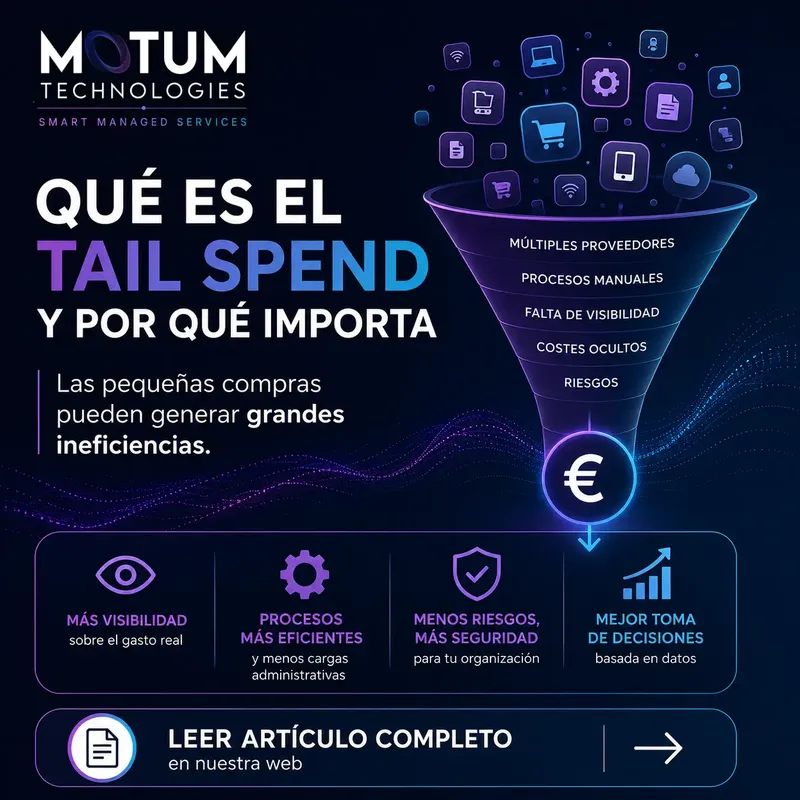
This group of purchases is known as Tail Spend and, far from being a purely financial concept, it has become one of the main challenges for companies that want to improve operational efficiency, reduce risk and move towards smarter management of their resources.
In a context where digitalisation is no longer just about adopting new technologies but about optimising how decisions are made, understanding the impact of Tail Spend is essential. Especially when it comes to technology purchases, IT infrastructure, communications services, industrial equipment or digital assets that directly affect business continuity.
Much more than small purchases
The most common mistake is to think that Tail Spend refers only to low-value purchases. The reality is much more complex.
The concept covers all the acquisitions that, because of their small individual volume or low recurrence, fall outside framework agreements and strategic purchasing processes. They usually represent a very high percentage of the total number of transactions a company makes, even though financially they add up to a smaller share of the overall budget.
It is common to find organisations where 80% of purchase orders are this type of acquisition, while they account for only 15 to 25% of total spending.
That is exactly where the problem lies.
Each of those transactions involves requesting quotes, validating needs, issuing orders, managing approvals, checking deliveries, processing invoices and making payments. The associated administrative cost often ends up being higher than any saving obtained by negotiating the purchase price.
When this is multiplied by hundreds or thousands of transactions a year, the financial impact stops being anecdotal and becomes a major productivity problem.
Tail Spend exists in technology too
In many companies, the technology department accounts for a significant share of this invisible spending.
Small software licences bought directly by different teams. Computers bought ad hoc to cover urgent needs. Network accessories. Communications equipment. Mobile devices. Automatic renewals of cloud services. One-off subscriptions to SaaS solutions. Industrial components for OT infrastructure. Digital subscriptions nobody remembers authorising.
Each decision seems reasonable when looked at individually.
The problem appears when none of them is part of an overall strategy.
That is when duplication arises: different suppliers for the same service, contracts with unfavourable terms, out-of-date inventories, difficulty controlling cybersecurity, and enormous administrative complexity that eats up the time of both the finance department and the technical teams.
That is why the most mature organisations have started to treat technology Tail Spend as a strategic issue and not just an administrative one.
A problem that affects much more than it seems
The consequences of Tail Spend rarely show up in a single budget line.
Its impact is usually spread across different departments and processes, which makes its true cost very hard to identify.
An organisation may believe it has excellent financial control because its large contracts are perfectly negotiated. At the same time, it may be losing hundreds of thousands of euros a year through repetitive purchases, manual processes, unnecessary administrative time or duplicate suppliers.
Beyond the financial impact, there is an operational component that often goes unnoticed.
Each additional supplier means new contractual terms, different invoicing systems, new approval procedures, different service levels and more follow-up.
As the number of suppliers grows, so does the complexity of managing risk, ensuring regulatory compliance and maintaining document traceability.
In industrial sectors or critical infrastructure, where technology availability is essential to guarantee operational continuity, this scenario can become a considerable risk factor.
When savings stop depending on price
There is a widespread idea that optimising purchasing means getting better discounts.
In reality, the most efficient organisations have understood that the real savings usually come from reducing complexity.
Reducing the number of suppliers, simplifying internal processes, centralising acquisitions or automating approvals generates far more sustainable benefits than negotiating a few percentage points off the purchase price.
Often, the biggest cost is not the product purchased, but the whole administrative process needed to buy it.
That is why modern Tail Spend management focuses on removing friction, cutting repetitive tasks and helping people spend their time on higher-value activities.
The importance of data
One of the biggest obstacles to controlling Tail Spend is the lack of consolidated information.
Many companies store purchasing data in different ERP systems, spreadsheets, contracting platforms, financial tools or departmental applications that barely share information with each other.
As a result, it is very hard to answer seemingly simple questions.
How many suppliers currently provide IT equipment?
How many different licences exist for the same function?
Which departments are contracting similar services?
Which contracts are about to expire?
Which spending categories are the most scattered?
Without a unified view it is practically impossible to make strategic decisions.
Data analytics applied to procurement uncovers patterns that normally remain hidden. With that information it becomes possible to consolidate suppliers, renegotiate contracts, eliminate duplication and design much more efficient purchasing policies.
The digital transformation of purchasing starts precisely with having reliable information.
Automation to regain control
In recent years, automation has profoundly changed the way organisations manage their internal processes.
Procurement is no exception.
Digital approval flows, integration between financial platforms, document management systems, artificial intelligence applied to contract analysis and supplier tracking tools all cut administrative time and minimise human error.
But automating does not simply mean replacing manual processes.
It means completely redesigning the way the organisation buys.
The companies that get the best results are the ones that manage to combine technology, processes and corporate governance under a single strategy.
There is little point in rolling out new platforms if each department keeps buying independently.
Technology needs to be accompanied by clear policies, common standards and an organisational structure able to sustain the change.
Tail Spend and cybersecurity: a less obvious relationship
One of the least known aspects of Tail Spend is its impact on technology security.
Each additional supplier means a new area of exposure.
Each piece of software bought without supervision can introduce vulnerabilities.
Each device connected to the corporate network is a new element that must be kept up to date and protected.
This phenomenon, commonly known as Shadow IT, is usually directly related to decentralised purchases that escape the control of the technology department.
The consequence is an ecosystem that is much harder to manage.
Managing Tail Spend also helps improve cybersecurity because it reduces technology sprawl, makes it easier to standardise solutions and improves the ability to supervise all the organisation's digital assets.
From traditional procurement to intelligent sourcing
The evolution of purchasing perfectly reflects how business management has changed over the last decade.
It used to be enough to buy at the best price.
Today it is essential to guarantee availability, resilience, sustainability, regulatory compliance, operational continuity and technology efficiency.
Sourcing has become a cross-cutting discipline involving finance, operations, technology, security, legal and senior management.
That is why more and more organisations are looking for specialist partners able to support them throughout the life cycle of technology supply.
It is not just about acquiring hardware or software.
It is about designing a sourcing model that can adapt to the company's growth, reduce risk and ensure that every technology investment adds real value to the business.
The role of a technology partner
Managing Tail Spend properly requires experience, methodology and market knowledge.
Organisations need to identify consolidation opportunities, evaluate suppliers, define technology standards, control contracts and ensure that every acquisition follows a common strategy.
This is exactly where a technology partner adds distinctive value.
Beyond supplying equipment, a specialist can help rationalise the technology catalogue, centralise purchasing, optimise licences, improve governance and significantly reduce the administrative burden on internal departments.
And when that support is combined with managed services, 24x7 support, cybersecurity, connectivity, IT/OT infrastructure and digital solutions development, the result is a completely unified view of the technology ecosystem.
That approach turns a collection of isolated purchases into a coherent technology strategy aligned with business goals.
An opportunity many companies have yet to discover
While many organisations keep focusing all their attention on large contracts, others are gaining significant competitive advantages through much smarter management of distributed spending.
Not because they buy less.
But because they buy better.
They reduce complexity, gain visibility over their processes, improve their negotiating power, lower technology risk and free up resources that can go into innovation.
Tail Spend is no longer just a financial issue. It is an indicator of an organisation's maturity, its ability to govern technology and the efficiency with which it turns investments into results.
In an environment where competitiveness depends more and more on agility and the ability to make data-driven decisions, controlling this scattered spending stops being an administrative task and becomes a real strategic advantage.
Companies that understand this reality find that optimising Tail Spend is not just about cutting costs. It is about building a more orderly, more secure and more efficient organisation that is ready for the technology challenges of the future. And that path is much easier with a partner able to integrate technology sourcing, IT and OT infrastructure, connectivity, cybersecurity, software development and managed services under a single strategy, so that technology stops being a collection of isolated purchases and becomes a real engine of business growth.