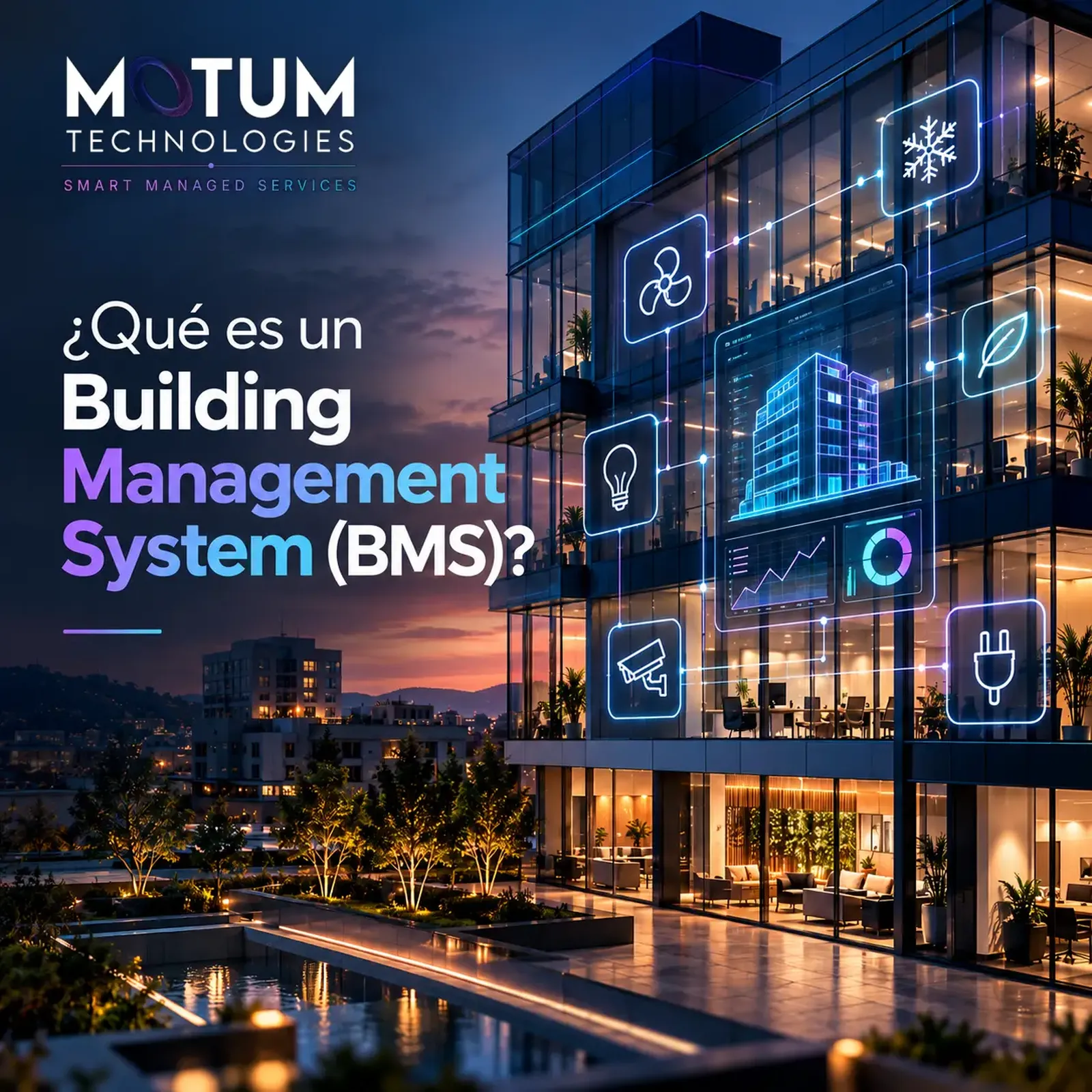

Buildings have ceased to be simple physical spaces and have become increasingly complex technological environments. HVAC systems, lighting, ventilation, electrical distribution, security, and communications coexist in facilities that must operate in a coordinated, efficient, and, above all, reliable manner. In this context, Building Management Systems (BMS) have established themselves as one of the fundamental technologies for managing modern buildings, optimizing their resources, and ensuring the continuity of their operations.
However, the true contribution of a BMS goes far beyond controlling the temperature of an office or scheduling the lights. Its ability to integrate facilities, collect operational information, and facilitate decisions makes these systems a strategic piece for organizations managing complex infrastructures, corporate buildings, hospitals, data centers, industrial facilities, or large commercial surfaces.
Understanding what a Building Management System is, how it works, and what requirements its implementation entails is especially relevant at a time when energy efficiency, service availability, and cybersecurity are priorities for any organization.
What is a Building Management System and what is it used for?
A Building Management System, commonly known as BMS or building management system, is a technological platform designed to supervise, control, and coordinate different technical facilities of a building from a centralized environment.
Its main function is to connect the systems involved in the daily operation of a facility, collect information about their status, and allow certain processes to be managed automatically or under the supervision of maintenance and operations personnel.
In a conventional building, HVAC, ventilation, lighting, and energy distribution systems may operate relatively independently. Each installation has its own controls, schedules, and supervision mechanisms. This fragmentation makes it difficult to obtain a complete view of the building's behavior and can cause inefficiencies that are difficult to identify.
A BMS introduces a layer of coordination that allows these installations to be related and managed according to predefined operational parameters. For example, it can adjust the HVAC system based on occupancy schedules, detect energy consumption deviations, or generate alerts when a piece of equipment behaves anomalously.
The result is a more structured management of the building, based on updated information and the possibility of intervening in its installations without relying solely on on-site inspections.
It is also important to distinguish between BMS and BAS, an acronym for Building Automation System. Although both terms are often used interchangeably, BAS usually refers to the automation and control of installations, while BMS emphasizes the platform for supervision and management of the whole. In practice, their functionalities can overlap considerably.
How a BMS works: from sensors to centralized management
The architecture of a Building Management System combines physical devices, communication systems, controllers, and software applications. Its operation depends on these elements being able to reliably exchange information and execute the necessary actions on the connected installations.
At the level closest to the building are the sensors and actuators. The former collect information on variables such as temperature, humidity, pressure, air quality, presence of people, or electricity consumption. The latter allow the operation of equipment to be modified through control commands, for example, regulating valves, fans, or lighting systems.
This information reaches controllers that interpret the signals and execute the configured operation logics. A significant part of the control is carried out locally, without the need for each decision to depend on a central server. This feature is especially relevant for maintaining essential functions when communication interruptions occur.
Above these devices is the supervision platform, from which operators can check states, visualize trends, modify authorized settings, and manage alarms.
Communication between components can rely on common building automation protocols, such as BACnet, Modbus, or KNX, depending on the type of installation and available equipment. Compatibility with these standards facilitates integration, although it does not in itself guarantee that devices from different manufacturers can exchange all their functionalities without adaptations.
In installations of certain complexity, the BMS can also connect with energy analysis platforms, maintenance applications, asset management tools, or corporate systems. It is precisely in this integration capability that some of the most interesting opportunities to improve operational management arise.
What installations can a Building Management System control
The scope of a BMS depends on the characteristics of the building, its needs, and the chosen technological architecture. Not all installations require the same degree of automation nor is it convenient to indiscriminately integrate all their systems.
HVAC, ventilation, and environmental quality. These are among the most common areas of application. The BMS allows supervising air handling units, chillers, boilers, pumps, fans, and other HVAC equipment. Based on the available data, it can adapt environmental conditions to occupancy, comfort, or technical operation requirements.
Lighting and electricity consumption. Coordinated management of schedules, zones, and lighting levels helps avoid unnecessary consumption. In parallel, monitoring electrical parameters allows analyzing demand, identifying anomalous behaviors, and providing more precise information on energy use.
Hydraulic systems and auxiliary services. Pumps, tanks, water circuits, and certain electromechanical equipment can also be incorporated into the supervision environment, facilitating the detection of incidents and the monitoring of their operating conditions.
Security and facility protection. Some BMS exchange information with access control systems, video surveillance, or fire detection systems. However, critical security and fire protection functions must maintain the independence and certifications required by applicable regulations. Integration is usually aimed at supervision and coordination, not replacing their specialized controls.
In buildings with particular technical needs, such as hospitals or data centers, certain environmental conditions and auxiliary equipment whose availability is essential for the activity can also be monitored.
This diversity explains why the design of a BMS should start from the real processes and risks of each installation, rather than simply incorporating as many connected devices as possible.
Energy efficiency as one of the main benefits of the BMS
Energy represents a significant portion of the operating costs of numerous buildings. Air conditioning, ventilation, and lighting account for a considerable share of consumption, especially in facilities with long working hours, large spaces, or demanding environmental requirements.
A BMS can help reduce consumption by allowing management more aligned with actual needs. Programming equipment according to occupancy, avoiding simultaneous heating and cooling operation, or identifying installations that remain active outside of scheduled times are examples of measures that can be applied through automation systems.
Its contribution also lies in the ability to measure and compare. When an organization has historical information about temperatures, schedules, equipment operation, and energy consumption, it can identify deviations and evaluate the results of corrective actions.
However, installing a BMS does not automatically guarantee a certain reduction in consumption. The results depend on the initial state of the building, the quality of instrumentation, control strategies, and maintaining configurations over time.
The ISO 52120-1 standard establishes a framework for evaluating the contribution of automation, control, and technical building management to its energy performance. Its existence reflects the importance of considering these systems within an integral efficiency strategy, rather than treating them as an isolated solution.
In this sense, the value of a BMS is consolidated when its data supports a process of continuous improvement and not only verifying that equipment is functioning.
Operational continuity: when the building is part of the business
In certain organizations, an incident in technical installations can have consequences that far exceed the cost of a repair.
A climate control problem in a data center can compromise the operating conditions of computer equipment. An environmental deviation in a pharmaceutical installation can affect processes subjected to strict control requirements. In a hospital, the availability of certain technical services is crucial to maintaining care activity.
In these environments, the BMS takes on a dimension linked to operational continuity.
Continuous monitoring facilitates detecting deviations before they become serious failures. A temperature that progressively increases, a pump working outside its usual parameters, or unexpected electrical consumption can generate alerts that allow investigation of the cause and faster action.
Event management is also relevant. A properly configured system allows establishing priorities, recording incidents, and providing information to the teams responsible for their resolution.
However, detection capability must be accompanied by operational procedures. An alarm is of no practical value if no one receives, interprets, or addresses it within the appropriate time frame.
Therefore, in critical buildings, technical supervision needs to be integrated with support, maintenance, and incident management services capable of ensuring a response proportional to the importance of each event.
This relationship between physical infrastructure, technology, and operations constitutes one of the areas where specialized managed services can provide significant value.
BMS and cybersecurity: protecting connected infrastructure
The evolution of Building Management Systems has increased their connectivity capabilities. Remotely accessible platforms, devices connected to IP networks, integrations with external applications, and digital maintenance tools offer new management possibilities but also expand the exposure surface to threats.
A BMS is part of the operational technology environment or OT when it supervises or controls the building's physical processes. Therefore, its security cannot be addressed exclusively based on traditional office IT equipment protection criteria.
Automation systems often have extended life cycles, devices with limited update capabilities, and operational dependencies that make it difficult to interrupt their operation for certain maintenance tasks.
Additionally, there is the participation of multiple suppliers: equipment manufacturers, integrators, maintenance companies, building operators, and technology departments. If access and responsibilities are not clearly defined, organizational and technical vulnerabilities may emerge.
Protecting a BMS requires knowing the connected assets, properly segmenting networks, controlling remote access, and maintaining logging and supervision mechanisms. It is also necessary to establish update, backup and recovery policies compatible with the operational requirements of the installation.
Recommendations from organizations like NIST and industrial security guides based on IEC 62443 offer references for addressing these risks in a structured manner.
For an organization, the objective is not only to prevent unauthorized access. It must also ensure that a cybersecurity incident does not unnecessarily compromise the building's essential physical functions.
IT/OT integration: one of the challenges of smart buildings
Building management has traditionally been linked to maintenance, engineering, and facilities departments. Meanwhile, IT departments have handled corporate networks, servers, applications, and digital services.
The increasing connectivity of BMS means that both disciplines need to collaborate much more closely.
A building management system may depend on communications networks, servers, databases, virtualized platforms, remote access services, and applications requiring specialized maintenance. At the same time, any technological modification must respect the operating conditions of connected physical equipment.
This coexistence raises questions that must be resolved from the design stage: who manages communications, how provider access is authorized, who monitors platform availability, and what procedures apply when an incident simultaneously affects IT and OT components.
Integration also poses difficulties related to existing installations. Many buildings incorporate equipment from different generations and manufacturers, with heterogeneous communication protocols and capabilities.
In these cases, an appropriate strategy can combine communication gateways, integration developments, and monitoring platforms that allow leveraging the installed infrastructure without requiring its complete replacement.
Interoperability must be technically evaluated, paying attention to available functionalities, security requirements, and the capacity for future maintenance.
The objective is not to connect systems for the sake of doing so but to build a coherent architecture that facilitates operation and reduces unnecessary dependencies.
From reactive maintenance to data-driven maintenance
One of the changes a BMS introduces is the ability to understand how installations behave over time.
In fundamentally reactive maintenance models, interventions occur when a breakdown appears or when a user reports an incident. Preventive programs improve this situation through periodic inspections, although they do not always reflect the actual state of each unit.
The information collected by a BMS can complement both approaches.
Tracking operating hours, temperatures, pressures, start cycles, and other parameters allows for detecting trends that justify an early inspection. For example, a growing difference between expected and recorded operating conditions may indicate performance loss, regulation problems, or maintenance needs.
When these data are integrated with Computerized Maintenance Management Systems, known as GMAO or CMMS, they can contribute to generating alerts, documenting interventions, and relating incidents to specific assets.
It is crucial to differentiate this capability from advanced predictive maintenance. The existence of historical data does not mean that a system can accurately anticipate failures. To develop reliable predictive models, sufficient information, record quality, technical knowledge, and result validation are needed.
In any case, the BMS provides a useful basis for evolving towards better-founded maintenance decisions.
How to choose and implement a BMS in an organization
The selection of a Building Management System should start with an assessment of the operational needs of the building and its current facilities.
A corporate building with regular schedules does not have the same priorities as a hospital, an industrial plant, or a data center. Neither do a new facility and a building that must incorporate automation on existing equipment require identical architecture.
The first step involves identifying which systems need to be monitored, which variables are relevant, and which control actions will provide verifiable benefits. This definition makes it possible to establish the functional scope and avoid investments in capabilities that will later not be utilized.
The technological choice must consider compatibility with installed equipment, available protocols, scalability, and the manufacturer's support conditions. It is also important to evaluate the ownership and accessibility of data, technical documentation, and future integration possibilities.
From an operational point of view, it is advisable to establish administration responsibilities, change management procedures, and continuity criteria. The start-up should include functionality tests, alarm validation, and training of the teams that will use the platform.
Experience shows that the post-implementation phase is especially important. Buildings evolve, occupants change, schedules are modified, and equipment is replaced. Without proper follow-up, the initially configured control strategies may lose effectiveness.
Therefore, the BMS lifecycle management must be considered from the start of the project.
The role of Motum Technologies in the technological management of buildings
A Building Management System is a specialized tool, but its reliable operation depends on a technological ecosystem that must be kept available, secure, and correctly integrated.
It is in this context that Motum Technologies can bring value to organizations managing buildings and complex infrastructures.
Through its Smart Managed Services, Motum contributes to the continuous monitoring and management of the technological infrastructures that support critical applications and operating systems. This approach is especially relevant when building management platforms depend on networks, servers, communications, and digital services requiring high levels of availability.
Their expertise in IT/OT infrastructure and connectivity allows them to address communication and integration requirements between automation systems, corporate environments, and management platforms, while their cybersecurity capabilities help establish appropriate protection measures for connected infrastructures.
Additionally, their software development and technology integration services allow studying specific interoperability needs, information exchange, and connection with business applications.
Motum's approach does not require replacing manufacturers or integrators specialized in building automation. Their contribution lies in managing complementary technological layers, integration between environments, and the necessary support to maintain reliable services over time.
For organizations with multiple buildings, distributed facilities, or processes sensitive to disruptions, having a partner capable of jointly understanding IT and OT requirements facilitates more coordinated technology management.
The future of BMS: connected buildings, analytics, and operational intelligence
Building Management Systems are evolving towards platforms capable of managing increasingly diverse information and facilitating more comprehensive oversight of facilities.
The incorporation of connected sensors, analytical tools, and digital models allows exploring new applications related to energy optimization, anomaly detection, and asset management.
In this scenario, so-called digital twins, virtual representations of assets or facilities that can use operational data to analyze their behavior, also become relevant. However, their usefulness depends on the quality of the information available and the accuracy with which the physical environment is represented.
Artificial intelligence opens additional possibilities for identifying complex patterns or proposing adjustments to operation, although its application in critical systems requires appropriate validation and monitoring mechanisms.
The evolution of these technologies is also influenced by sustainability and energy efficiency demands. In Europe, Directive (EU) 2024/1275 concerning the energy efficiency of buildings strengthens the role of automation and control in certain buildings, with requirements and timelines that must be interpreted according to their scope and national implementation.
Beyond specific technologies, the fundamental change consists of moving from managing installations in isolation to understanding the building as a set of interdependent systems.
A well-designed BMS contributes to this evolution, but it needs reliable technological infrastructure, a security strategy, and an organization capable of transforming data into operational decisions.
For companies that rely on the availability of their facilities, the true value of the smart building is not merely in incorporating automation. It lies in ensuring their systems operate in a coordinated way, that incidents can be detected and managed quickly, and that technology accompanies the real needs of the business.
In short, a Building Management System represents an important tool for moving towards more efficient, connected, and manageable buildings. Its success, however, depends on both the quality of the implemented solution and the ability to maintain, protect, and integrate it into the organization's overall technological infrastructure.
Frequently asked questions
Sources & further reading
 CSRC | NIST ↗Guide to Operational Technology (OT) Security — NISTThis document provides guidance on how to secure operational technology (OT) while addressing their unique performance, reliability, and safety requirements. OT encompasses a broad range of programmable systems and devices that interact with the physical environment (or manage devices that interact with the physical environment). These systems and devices detect or cause a direct change through the monitoring and/or control of devices, processes, and events. Examples include industrial control systems, building automation systems, transportation systems, physical access control systems, physical environment monitoring systems, and physical environment measurement systems. The document provides an overview of OT and typical system topologies, identifies common threats and vulnerabilities to these systems, and provides recommended security countermeasures to mitigate the associated risks.
 iso.org ↗ISO 52120-1:2021 — Energy Performance of Buildings
- eur-lex.europa.eu ↗Directive (EU) 2024/1275 on the Energy Performance of Buildings — EUR-Lex
- CSRC | NIST ↗Guide to Operational Technology (OT) Security, Revision 4 — Initial Public Draft — NISTThis document provides guidelines on how to secure operational technology (OT) while addressing their unique performance, reliability, and safety requirements. OT encompasses a broad range of programmable systems and devices that interact with the physical environment, such as industrial control systems, building automation and control systems (BACS), freight railroad, maritime vessels, water and wastewater systems (WWS), Industrial Internet of Things (IIoT), and cloud environments. This document provides an overview of OT and typical system topologies, identifies common threats and vulnerabilities to these systems, and offers recommended security countermeasures to mitigate the associated risks in alignment with the NIST Cybersecurity Framework (CSF) 2.0.
 BACnet Committee ↗BACnet — ASHRAEWebsite of the BACnet Committee (ASHRAE SSPC 135)
 Motum Technologies ↗How to calculate the cost of service downtime Aprende a calcular el coste real de una caída de servicio, desde productividad y operación hasta recuperación, ventas y continuidad de negocio.
 Motum Technologies ↗The 10 most common mistakes in OT cybersecurityDescubra los 10 errores más frecuentes en ciberseguridad OT que ponen en riesgo la continuidad industrial y cómo prevenirlos con una estrategia IT/OT eficaz.
 Motum Technologies ↗The most common mistakes in automation projectsDescubre los errores más comunes en proyectos de automatización empresarial y cómo diseñar procesos integrados, seguros, mantenibles y preparados para evolucionar.
 Motum Technologies ↗Why the most efficient organizations invest differentlyDescubre por qué las organizaciones más eficientes invierten diferente en tecnología y cómo infraestructura, software, ciberseguridad y servicios gestionados mejoran la eficiencia.
 Motum Technologies ↗Managed Services — Smart Managed ServicesServicios gestionados IT/OT desde Barcelona, con monitorización 24x7, ciberseguridad y soporte experto para dar continuidad a tus operaciones críticas.