

Talking about automation in a company has meant thinking about very specific tasks. A macro that removed a few hours of administrative work, a workflow that saved sending several emails or an integration that avoided entering the same data into two different applications. The approach was simple: find a repetitive task and a way to do it with less human intervention.
That model still makes sense. What is changing, however, is the scale.
As companies add more applications, generate more data and connect a larger share of their operations, automating an isolated task becomes only a small part of the problem. The real leap happens when different systems are able to share information, interpret what is happening and trigger actions in a coordinated way.
That is where talking about hyperautomation starts to make sense.
This is not a specific technology, nor the next buzzword to replace automation. In fact, behind the concept lies a far more interesting idea: combining technologies that many organisations have so far managed separately —artificial intelligence, RPA, integration, analytics, process mining, APIs or business software— to work on complete processes.
The change may seem semantic. It is not. Because automating tasks is one thing, and getting an organisation to work as a connected whole is quite another.
When the process matters more than the task
Consider a common situation in an industrial company. A critical infrastructure component starts showing signs of degradation and needs to be replaced.
In a conventional environment, someone will detect the problem and open an incident. Then the inventory will have to be checked, the availability of a spare confirmed, authorisation requested if needed, purchasing contacted, a supplier found, the order placed and the delivery coordinated. Later it will be time to schedule the intervention, carry it out and document what happened.
A considerable share of those activities is probably already digital. The incident will be logged in one application, the inventory in another, and the order will end up in the ERP. There may even be partial automations between some of those steps.
And yet someone is still acting as the bridge between the systems.
A more automated organisation could handle the same situation differently. Monitoring detects abnormal behaviour. The system identifies the asset, checks its history and verifies whether a spare part is available. If not, it can review approved suppliers or contract terms and prepare the procurement. Depending on cost or criticality, it will ask a person for authorisation or continue the process within previously set limits. At the same time, it could book a maintenance window and keep the people responsible informed.
What is interesting is not counting how many steps have been automated.
What is interesting is that the process starts to work as a whole.
And that is probably one of the best ways to understand where business hyperautomation is heading.
The problem will not be having more tools
Most medium-sized and large companies do not exactly suffer from a lack of technology.
There are ERPs, CRMs, Business Intelligence tools, corporate applications, cloud platforms, in-house software, cybersecurity solutions, document management systems and, in industrial organisations, a whole additional layer of operational and production systems.
Artificial intelligence and automation tools are now being added to this ecosystem extremely quickly.
The result can be extraordinarily powerful. It can also become a problem.
Each department can start creating its own workflows, subscribing to SaaS applications, using AI assistants or building small automations to meet immediate needs. They all work reasonably well on their own, but a few years later nobody has a complete view of how they relate to one another.
It is quite an easy situation to imagine because, to some extent, it is already happening.
That is why the future of automation will depend less on accumulating tools and much more on getting tools to work together.
APIs, integration platforms, data models and identity systems may be less eye-catching than a new artificial intelligence agent, but they will be an essential part of this evolution. If information cannot move reliably between applications, automation capability will remain fragmented.
In that sense, hyperautomation is also an architecture problem.
Artificial intelligence widens the playing field
Until relatively recently, automation worked especially well when the rules could be written down clearly.
If A happens, do B. If an invoice exceeds a certain amount, ask for a second approval. If a sensor exceeds a threshold, raise an alert. If an order changes status, send a notification.
The problem is that much of a company's daily work does not fit comfortably within rules of this kind.
There are emails that need interpreting. Documents in different formats. Incidents described in an unstructured way. Requests written in natural language. Situations in which the decision depends on several sources of information and a certain amount of context.
Artificial intelligence is starting to push back precisely that frontier.
It is now possible to classify documentation, extract information, summarise incidents, identify patterns or prepare recommendations using information that previously needed to be reviewed by a person.
That does not automatically make the process autonomous, but it allows automation to be introduced in places where it was hard to do so until now.
And the arrival of agentic AI takes that possibility a little further.
From the assistant that answers to the system that acts
The first generation of generative artificial intelligence to reach companies on a large scale has worked, to a large extent, as a copilot.
A person asks and the tool answers.
It can draft a text, summarise a document, help with code or analyse certain information. But there is usually a fairly clear break between the AI's answer and the action that follows. It is the person who decides what to do.
Agents are starting to change that relationship.
Instead of just producing an answer, they can receive a goal and use different tools to work towards it. Query a database, retrieve information from an application, call an API, execute an action or check whether the result is as expected.
Consider a technology support environment.
Today we can ask an AI which critical incidents are open and ask it to summarise them. Tomorrow, the system could continuously review those incidents, relate them to infrastructure events, consult technical documentation, set an initial priority and prepare a proposed course of action. Known situations could follow a previously authorised procedure. Exceptions would reach a specialist with much of the groundwork already done.
This changes an important question.
We will no longer only have to decide what we want to automate. We will also have to decide how much autonomy we want to give each automation.
Not every process will need the same level of oversight. Some will be able to run practically on their own. Others will require human approval before carrying out certain actions. And there will be decisions that, because of accountability or their very nature, must remain in a person's hands.
Without good data, automation just gets things wrong faster
Every new technology wave brings a familiar temptation: focusing on the visible part and forgetting everything underneath.
It is happening again with artificial intelligence.
We may have a very advanced agent, but if it works with incomplete, duplicated or out-of-date information, its results will be as unreliable as the data it receives.
Hyperautomation therefore forces us to return to issues that have been on the table for years: data quality, integration, governance, permissions, traceability and defining reliable sources.
The difference is that the consequences are now greater.
Until recently, a wrong piece of data could end up in a dashboard and lead to a misinterpretation. In an automated environment, that same piece of data can trigger an action.
Information is no longer used only to explain what has happened. It also starts being used to decide what should happen next.
That change is important.
ERPs, CRMs, sensors, internal applications, supplier platforms and industrial systems constantly generate information. A hyperautomated company needs to be able to capture it, put it in context and make it available to the right processes without losing control over it.
Data goes from being an analytical asset to also becoming an operational asset.
When automation reaches the physical world
In an industrial, energy, logistics, healthcare or transport company there is also another dimension that cannot be ignored.
Not everything happens inside business applications.
There are machines, sensors, PLCs, SCADA systems, industrial networks and field devices that describe, practically in real time, what is happening in operations.
When that information can be securely linked to corporate systems, especially interesting scenarios appear.
An anomaly detected in a machine can start a maintenance process. A change in production can alter logistics needs. Consumption outside the usual parameters can trigger a review. An incident can be analysed using information from IT infrastructure, applications and industrial operations at the same time.
This does not mean connecting IT and OT without restrictions. That would be exactly the opposite of what is advisable.
Industrial environments have particular availability, segmentation and security needs. Any integration must respect them. But between keeping both worlds completely isolated and connecting everything indiscriminately there is a huge space in which a well-designed architecture can add value.
And it is in that space that much of the industrial automation of the coming years will find its ground.
The more we automate, the more we depend on everything working
There is a less visible consequence of this evolution.
A small automation can fail and become a nuisance. An automated process on which thousands of daily operations depend is another story.
When technology starts carrying out a growing share of processes, its availability directly becomes business availability.
It is no longer enough to know whether a server is running or a network has connectivity. You also need to know whether integrations are responding, whether APIs are available, whether data is arriving correctly and whether automated processes are running as they should.
Observability thus starts to move beyond the infrastructure to reach the process itself.
This evolution makes the Smart Managed Services model especially relevant. 24x7 monitoring, incident management, maintenance, connectivity, infrastructure, cybersecurity and continuous improvement stop being independent layers and become part of the operational support of an increasingly digital organisation.
At Motum Technologies we see this reality from an integrated perspective. IT/OT infrastructure, software development, connectivity, cybersecurity and managed services make less and less sense when treated as watertight compartments. Continuity depends precisely on how they work together.
And who controls what a machine can do?
This question will become increasingly common.
While an artificial intelligence only summarises documents, the risk associated with its permissions is relatively limited. But the moment it can modify a record, consult confidential information, start an order or act on another application, the situation changes.
An agent needs an identity.
It needs permissions.
And it needs limits.
Access management, the principle of least privilege, segregation of duties and traceability will also have to be applied to these new digital actors.
It would make no sense to give an agent unlimited access simply because it technically needs it to complete a task. Just as with a person, its permissions should be limited to the functions it needs, with additional controls when an action has significant consequences.
It will also be necessary to know what it did, when it did it, what information it used and why it took a particular route within the process.
Automation multiplies speed. That is precisely what makes it valuable.
But it also means a poorly controlled error can spread at that same speed.
People will still be there, but in a different place
Every time a new generation of automation appears, the same question comes back: what will happen to people?
The answer is probably far less spectacular than some headlines suggest.
In many activities, machines will take on a growing share of repetitive work, information searching and coordination between applications. They will also be able to carry out preliminary analysis and resolve known situations within set parameters.
People will shift towards the exceptions.
A technician may stop manually reviewing hundreds of alerts and receive only those that require specialist judgement. A purchasing manager will be able to work on comparisons the system has already prepared. An administrative professional will spend less time moving information from one application to another. An IT team will be able to cut back some routine tasks and focus on architecture, security and evolution.
It will not be the same process in every company or every role.
But it is probably more useful to ask how work will be shared between people and systems than to try to work out how many tasks will disappear.
Automating for the sake of it is not a strategy
There is another idea worth keeping in mind: not everything that can be automated deserves to be.
Some processes happen very rarely. Others change constantly. Some depend too much on context. And there are decisions where deliberately keeping human responsibility may be the right choice.
We also find processes that are simply badly designed.
Automating them does not solve that problem. Sometimes all we achieve is carrying out a bad way of working much faster.
Before adding technology, it is worth understanding what is happening: where the waits occur, what information is missing, which steps add no value, which exceptions are common and what result we want to improve.
Only then does it make sense to decide whether we need integration, software, AI, automation or a combination of all of them.
Hyperautomation should not be a race to eliminate clicks. It should be a way to redesign how the organisation works.
The advantage will not lie in having more agents
Over the next few years we will see many of these capabilities stop being exceptional.
ERPs will incorporate more artificial intelligence. CRMs will do the same. Cloud platforms will offer agents, automation and integration natively. Tools that today require specialist knowledge will become increasingly accessible.
That means having the technology will not necessarily be a competitive advantage.
Practically everyone will be able to buy it.
The difference will appear somewhere else: in how the architecture behind it has been built.
Can a system find the data it needs? Do we know which source is reliable? Do the applications have suitable APIs? Who authorises an action? Can we stop a process if something fails? Do we know which automations depend on a specific application? What happens when we replace that application? Who monitors the whole ecosystem?
These questions are far less eye-catching than talking about artificial intelligence.
They are also the ones that will determine whether it works.
The hyperautomated enterprise will not necessarily be the one with the most robots, automations or AI agents. It will be the one that has managed to coordinate technology, information and people around its processes.
From implementing technology to sustaining a capability
Perhaps one of the deepest changes is precisely this one.
For years we have understood much of business technology in the form of projects: implementing an ERP, renewing servers, developing an application, deploying a data platform or automating a process.
Each project had a beginning and, at least on paper, an end.
Hyperautomation fits that logic rather poorly.
An automation needs an application. The application depends on an API. The API needs infrastructure. The process consumes data from different systems. Users and agents need permissions. Everything must be protected and monitored. And when any of those pieces changes, you have to review how it affects the others.
Technology looks less and less like a succession of finished projects and more like a business capability that must be kept in motion.
This approach connects directly with Motum Technologies' offering. Software development, IT/OT infrastructure, connectivity, cybersecurity and Smart Managed Services are part of the same technology ecosystem. Not because every company needs to contract all of them, but because it is increasingly difficult to evolve one of those areas while ignoring the others.
An automation adds little value if it stops working every time an application changes.
Neither will an intelligent agent if it uses incorrect information.
And the best data platform will be of little use if the infrastructure supporting it is not reliable.
The future is already starting, but it will be less spectacular than we imagine
It is unlikely that a traditional company will wake up one Monday morning as a hyperautomated organisation.
The change will be much more gradual.
First, some manual tasks will disappear. Then applications will be connected. Data will start to flow more easily between departments. Some simple decisions will be executed automatically. Artificial intelligence will make it possible to work with less structured information. Agents will take on certain actions, and people will step in mainly when an exception appears.
One day, looking back, we will discover that a considerable part of the organisation works in a very different way.
Not because someone ran a big project called "hyperautomation", but because the necessary pieces were built over the years.
That is why perhaps the most useful question for a company is not when hyperautomation will arrive.
The question is whether the technology architecture it is building today will be ready for it.
Understandable processes. Reliable data. Applications able to integrate. Available infrastructure. Secure connectivity. Software development when the standard is not enough. Cybersecurity built in from the design stage. And technology operations able to keep that whole ecosystem running and evolving.
The hyperautomated enterprise will not be a company without people.
Nor will it be a company run by robots.
It will probably be an organisation in which people and systems have learned to share the work much better.
And that may be the really important change.
Frequently asked questions
Sources & further reading
 ibm.com ↗What Is Hyperautomation? — IBMHyperautomation is the concept of automating everything in an organization that can be automated.
 ibm.com ↗Intelligent Automation vs. Hyperautomation — IBMExplore the differences between intelligent automation and hyperautomation in digital process automation.
 gartner.com ↗Market Opportunity Map: Hyperautomation via Process-Agnostic Software, Worldwide — Gartner
- gartner.com ↗Optimize Automation Using the Hyperautomation Maturity Model — Gartner
 techtarget.com ↗Agentic AI workflows: Trends, examples and best practices — TechTargetTechTarget delivers enterprise IT news, expert advice and research on AI, cybersecurity, infrastructure and IT strategy to help you make smarter tech decisions.
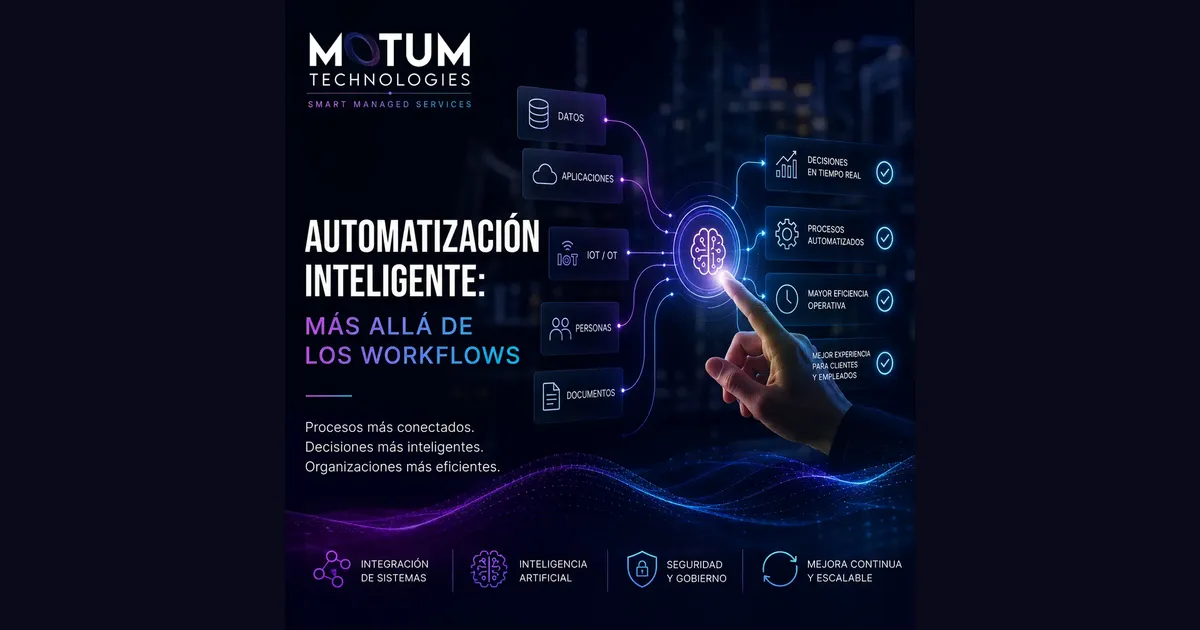 Motum Technologies ↗Automatización inteligente: más allá de los workflowsDescubre cómo la automatización inteligente permite optimizar procesos, mejorar la eficiencia operativa e integrar sistemas empresariales más allá de los workflows tradicionales.
 Motum Technologies ↗5 procesos que deberías automatizar antes de contratar más personalDescubre cinco procesos que puedes automatizar para mejorar la eficiencia, reducir costes y crecer sin aumentar plantilla. Guía práctica de Motum Technologies.
 Motum Technologies ↗AI Governance: framework de 5 pilares para empresas¿ERP estándar o software a medida? Qué opción encaja mejor con tus procesos, costes, integraciones y estrategia tecnológica empresarial.
 Motum Technologies ↗Cómo crear una cultura basada en datosDiscover how to build a data-driven culture to improve decision-making, accelerate digital transformation and increase business competitiveness.
 Motum Technologies ↗Desarrollo de Software — Motum TechnologiesCreamos soluciones digitales que conectan tecnología, datos y operaciones para impulsar la eficiencia y la continuidad del negocio.