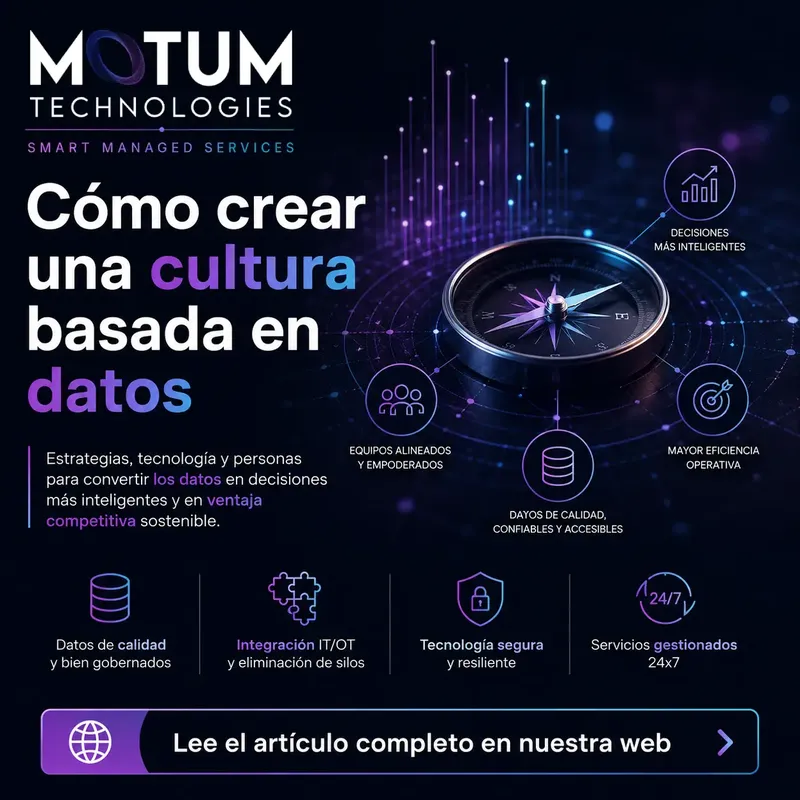
Digital transformation has always been understood as an essentially technological process. Organisations invested in new ERPs, migrated applications to the cloud, deployed Business Intelligence platforms or added IoT sensors, expecting these projects on their own to change the way they worked. However, experience across practically every sector shows that technology is rarely the main obstacle. The real challenge is getting people to make decisions differently.
This explains why so many digitalisation initiatives deliver less than expected. The company has more information than ever, but keeps acting on inertia, intuition or decision structures inherited from another era. The reports exist, and so do the dashboards, but they are still used only to justify decisions already made rather than as the starting point for making them.
Building a data-driven culture means precisely breaking with that model. It means turning information into a strategic asset that supports every relevant decision in the organisation, from financial planning to industrial maintenance, including sales management, customer experience and operations optimisation.
It is not just about collecting data. Nor is it about implementing more sophisticated tools. A truly data-driven company develops a different way of thinking, in which every important decision can be explained, measured and improved thanks to the information available.
In a context where markets change quickly, supply chains are increasingly complex and competitive pressure keeps rising, this capability stops being a differentiating advantage and becomes a necessary condition for staying competitive.
Data as the organisation's common language
One of the most common mistakes is to think that a Data Driven strategy belongs exclusively to the technology department or the analytics team.
In fact, exactly the opposite is true.
The organisations that achieve the best results are those where data stops belonging to a particular department and becomes a language shared by every business area.
When a CFO analyses the return on an investment, an operations manager reviews productivity indicators or a sales director studies customer behaviour, they are all using different expressions of the same business reality.
This shared view greatly reduces discussions based on individual perceptions. Meetings stop centring on opposing opinions and focus instead on interpreting the information available and deciding how to act.
This does not mean experience disappears. Intuition is still important, especially in people with many years of business knowledge. What changes is that this experience is now complemented by objective evidence.
The most mature organisations understand that the best decision usually comes precisely from combining human knowledge with analytical capability.
Much more than Business Intelligence
There is a certain tendency to equate a data-driven culture with implementing Business Intelligence platforms. Although these solutions are an important piece, they are only one part of the ecosystem.
An excellent dashboard does not transform a company if people keep making decisions exactly as they did before.
Just as having an ERP does not guarantee good business management, having advanced dashboards does not guarantee a data-driven organisation either.
The difference appears when information becomes part of everyday work.
Teams start every meeting by reviewing relevant indicators.
Projects are evaluated using previously defined metrics.
Investments are prioritised by considering quantified scenarios.
Processes are continuously optimised based on measurable results.
Mistakes are no longer hidden because they are learning opportunities backed by objective information.
At that point data stops being a monthly report and becomes a daily management tool.
Data quality determines decision quality
There is a widely accepted maxim in technology: no organisation can make decisions better than the quality of the information it works with.
Many companies discover this problem when they try to build advanced analytical models and find that their data contains duplicates, inconsistencies, incomplete records or multiple versions of the same reality.
It is not a technology problem.
It is an organisational problem.
For years, different departments have generated information using different criteria, independent applications and poorly coordinated processes.
The result is an organisation where sales handles one set of data, operations works with another and finance uses different figures to analyse exactly the same business.
In this context it is practically impossible to build reliable analysis or prediction models.
That is why any data-driven strategy starts long before talking about artificial intelligence, advanced analytics or automation.
It starts by setting clear data governance policies, defining who is responsible for information, standardising processes and making sure every department works from a single source of truth.
This discipline, known as Data Governance, is one of the least visible and, at the same time, most important pillars of any digital transformation project.
Cultural change starts at the top
Many Data Driven initiatives fail because they are presented as technology projects when, in reality, they represent profound changes in the way an organisation is run.
If the management committee keeps making decisions based solely on personal perceptions, the rest of the company is unlikely to change its habits.
Culture is always passed down from the top.
Leaders set which behaviours are valued, which indicators get attention and which kinds of decisions are recognised within the organisation.
When a CEO asks for data before approving an investment, when a COO demands objective metrics to assess operational efficiency or when a CIO promotes indicators shared across departments, the message the whole company receives is clear: decisions must be based on evidence.
This change also alters the way mistakes are managed. In traditional organisations, a negative result is usually seen as a failure.
Data-driven companies see it as useful information for learning faster.
Each project generates new knowledge that makes it possible to adjust processes, redefine hypotheses and continuously improve business performance.
This mindset is especially relevant in innovation processes, where few decisions can be fully guaranteed before they are carried out.
Democratising access to information
For many years, business information remained concentrated in a few specialised profiles.
Requesting a report could take several days of work from the IT or analytics department.
Today that situation makes no sense.
Modern platforms allow each area to have up-to-date information practically in real time. However, democratising access to data does not mean handing over huge volumes of information without context.
It means giving each professional exactly the indicators they need to do their job better.
A maintenance manager needs to know incident trends, asset availability and mean repair times. The sales team needs information on open opportunities, pipeline evolution, customer behaviour and closing forecasts. Finance needs to control margins, budget deviations and cash flow trends.
Each profile consumes different data, but they all work on the same information architecture. This approach speeds up decision-making and significantly reduces dependence between departments. It also increases team autonomy and fosters a culture of accountability based on measurable results.
Technology at the service of the business
A data-driven culture is not about accumulating tools. It is about building a technology infrastructure capable of turning scattered information into actionable knowledge.
This is where having a technology partner able to understand the business, the infrastructure and each organisation's operational needs all at once becomes especially important.
Integration between systems, secure connectivity, interoperability between IT and OT environments, permanent service availability and information protection are all part of the same strategy.
When these elements work together, the organisation can trust that the data reaching its dashboards faithfully represents the reality of the business. Only then is it possible to move towards more ambitious scenarios, such as predictive analytics, intelligent automation or artificial intelligence applied to decision-making.
In this context, companies such as Motum Technologies help organisations build that technology ecosystem comprehensively. Not just by implementing technology solutions, but by designing robust infrastructure, connecting systems, ensuring the quality and availability of information and supporting companies throughout their digital transformation. This approach is especially relevant in industrial sectors and organisations where operational continuity, security and integration between technologies are critical factors in turning data into a genuine competitive advantage.
From descriptive data to data that anticipates the future
An organisation that is truly mature in its use of data does not stop at explaining what has happened. That is only the first level of analytics and, although it is essential for understanding business performance, it offers a retrospective view. The real competitive leap comes when information makes it possible to understand why a particular result occurred, anticipate what may happen next and even recommend the best possible decision based on multiple variables. At that point, data stops being a historical record and becomes a strategic asset able to guide the organisation's future.
This evolution marks a fundamental difference between companies that simply produce reports and those that have managed to build information analysis into their regular decision-making process. In an industrial plant, for example, knowing the number of incidents recorded in the last quarter is useful for assessing operational performance. However, the real value appears when the organisation is able to detect recurring patterns, link those incidents to certain production conditions or identify early signals that make it possible to intervene before a breakdown stops production.
The logic is exactly the same in any other area of the company. In sales, reviewing last year's sales gives a snapshot of the business, but it is far more relevant to identify which customers are most at risk of leaving, which opportunities are most likely to become contracts or which sales actions generate a significantly higher return than the rest. Information then stops describing the past and becomes a tool that helps build the future.
This predictive capability does not appear spontaneously. It requires years of work consolidating data quality, integrating systems, removing duplicates and building governance processes that make it possible to fully trust the information available. Only when those foundations are firmly in place is it possible to move towards more sophisticated analytical models and exploit the full potential of technologies such as artificial intelligence or machine learning.
Breaking down information silos to build a single view of the business
Few barriers hold back the development of a data-driven culture as much as fragmented information. It is a common situation in organisations that have grown over the years by adding new applications to meet specific needs: an ERP for business management, a CRM for sales, specific solutions for maintenance, HR platforms, financial systems or in-house applications for very particular processes.
Each of these tools does its job properly, but usually in isolation. Data stays locked inside each system, follows different criteria and, in many cases, uses structures that are incompatible with one another. The result is that each department ends up building its own view of the business, making it extremely difficult to obtain an overall perspective.
This fragmentation has far deeper consequences than it seems. When management needs to understand the impact of a given decision, discover the relationship between variables or analyse the full behaviour of a business process, the information is simply not ready to answer. Seemingly simple questions, such as the relationship between production incidents and the profitability of certain customers, how downtime affects service level agreements or the impact of a logistics incident on customer satisfaction, become complex exercises that require combining information from multiple systems.
That is why a data-driven strategy cannot be limited to implementing new analytics tools. First, it is essential to build a technology architecture able to integrate information, connect applications, set common criteria and ensure the whole organisation works on a single version of reality. Only when these information silos disappear is it possible to make truly cross-functional decisions and align every department behind the same view of the business.
People are still the real engine of a Data Driven organisation
There is a growing tendency to associate data-driven transformation with adopting ever more advanced technologies. However, no matter how sophisticated analytics platforms become, the real change still happens in people. A company can invest millions of euros in technology infrastructure and keep making decisions exactly as it did ten years ago if its professionals do not change the way they interpret information.
That is why one of the least visible, yet most decisive, pillars of any Data Driven strategy is developing a genuine culture of data literacy. It is not about turning every employee into a data scientist or demanding advanced technical knowledge. It is about ensuring that any professional, whatever their responsibility, can understand the indicators they work with, interpret trends, identify anomalies and ask questions that help continuously improve processes.
When this capability starts to spread throughout the organisation, the changes are profound. Meetings stop revolving around personal opinions and rely on objective evidence. Hypotheses can be validated quickly. Projects are evaluated through measurable results and teams gain far greater autonomy to make well-founded decisions.
In addition, the organisation reduces its dependence on a few specialised profiles able to interpret information. Knowledge is democratised and data stops being the exclusive preserve of technical departments, becoming an everyday tool at the service of the whole company.
Artificial Intelligence only adds value when there is a data culture
The rise of Artificial Intelligence has led many organisations to want to accelerate their digitalisation by adopting algorithms capable of automating decisions, making predictions or generating recommendations. However, experience shows that Artificial Intelligence does not replace a data-driven strategy; it simply amplifies its strengths... or its weaknesses.
AI models depend entirely on the information they are trained on. If the data contains errors, duplicates or inconsistencies, or lacks sufficient context, the conclusions obtained will reproduce exactly those same limitations. That is why, before launching Artificial Intelligence projects, organisations need to answer much more fundamental questions: where the information really lives, who is responsible for it, what quality it has, how it is kept up to date and under what criteria it can be used.
Answering these questions properly means having travelled a good part of the road towards a Data Driven organisation. Artificial Intelligence is not the start of that transformation, but a logical consequence of having first built a solid technology architecture, a data governance strategy and an organisational culture ready to work with reliable information.
The companies that get the greatest return from AI over the coming years will probably not be those that adopt the technology first, but those that have spent time developing a genuine data-driven culture.
Data security is also a competitive advantage
As organisations rely more and more on information to manage critical processes, cybersecurity stops being just a technology matter and becomes an inseparable part of business strategy. After all, a company that makes decisions on manipulated, incomplete or inaccessible data is directly compromising its ability to compete.
This challenge takes on an even greater dimension in industrial sectors, critical infrastructure or environments where IT and OT systems converge. Every connected sensor, every IoT device and every production system generates information that is essential to ensure operational continuity. Protecting that information also means protecting the company's ability to keep running normally.
That is why the move towards a data-driven culture must consider, from the start, cybersecurity, system availability, infrastructure resilience and protection against increasingly sophisticated threats. Information only creates value when it can be consulted with confidence, knowing that it keeps its integrity and remains available when the organisation needs to make decisions.
A strategic shift that will define competitiveness in the next decade
Everything suggests that over the coming years the difference between the most competitive organisations and those that will struggle most to adapt will not depend only on their ability to adopt new technologies. The real difference will lie in the ability to turn huge volumes of information into useful, accessible and actionable knowledge.
Companies will keep generating data from customers, operations, connected devices, industrial systems, corporate applications or digital platforms. However, having more information will not guarantee better decisions. The advantage will belong to those organisations able to integrate all that data, interpret it quickly and turn it into concrete actions that improve efficiency, reduce risks and accelerate innovation.
Building that capability requires a comprehensive view of digital transformation. It demands resilient infrastructure, interconnected platforms, secure environments, well-defined processes and professionals ready to work with information as part of their daily activity. In short, it requires understanding that a data-driven culture is not a technology project with a start and end date, but a different way of running the company.
On that journey, having a specialised technology partner makes a significant difference. At Motum Technologies we support organisations in sectors such as industry, energy, healthcare, retail, transport and public administration in building digital ecosystems ready to turn data into a sustainable competitive advantage. Through our Smart Managed Services and our capabilities in IT/OT integration, cybersecurity, software development, infrastructure and connectivity, we help create environments where information stops being a scattered resource and becomes the engine that drives faster, safer and better-founded decisions.
Because the real value of data does not lie in the amount of information a company can store. It lies in its ability to turn it into knowledge, turn that knowledge into decisions and make those decisions have a real impact on the business. That is, ultimately, the essence of an organisation truly ready to compete in the future.