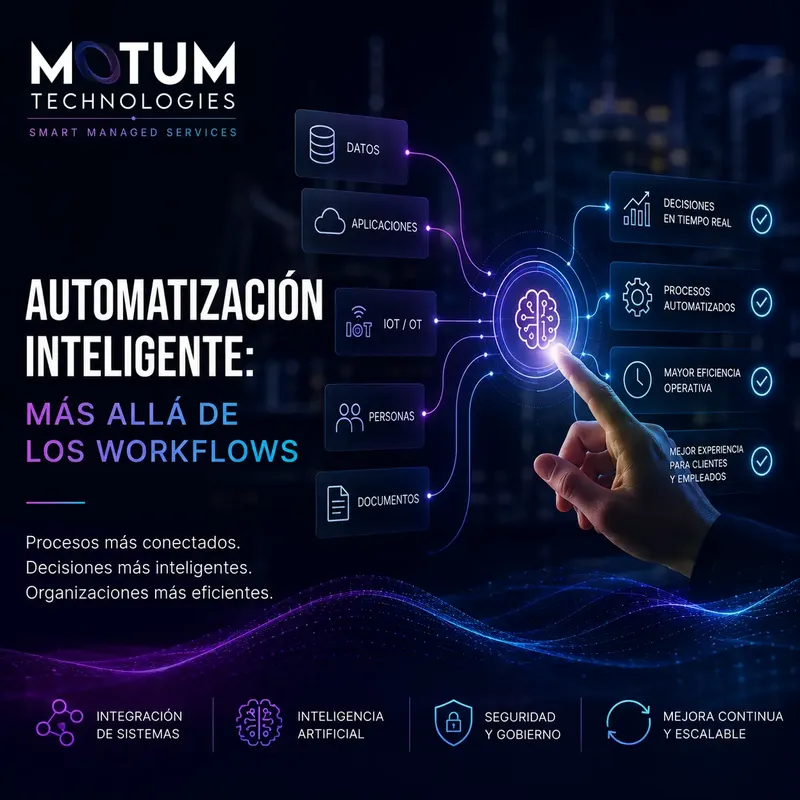
Digital transformation has filled companies with applications, platforms, and tools capable of automating practically any task. However, there is a paradox that is becoming increasingly evident: many organizations have invested years in digitizing processes and still operate with a huge amount of manual work.
Emails awaiting approval, data that an employee copies from one application to another, documents that pass through several departments before receiving the green light, or incidents that depend on someone remembering to perform a specific action. These are small inefficiencies that, when viewed in isolation, seem manageable. The problem is that when multiplied by hundreds of daily operations, they end up becoming one of the largest hidden costs in any organization.
For a long time, the answer was to implement workflow tools. Those systems allowed the automation of certain repetitive tasks through simple rules: if an event occurs, an action is executed. It was an important step forward from completely manual processes and, in many cases, represented a significant leap in productivity.
But the corporate context has changed.
Companies no longer work on a single application. ERPs, CRMs, cloud platforms, custom-developed applications, hybrid infrastructures, IoT sensors, industrial systems, and external services coexist, constantly generating information. Processes span entire departments and rely on data from multiple sources. In this scenario, limiting automation to a set of predefined rules is insufficient.
Intelligent automation precisely emerges to respond to this new reality. It is not just about executing tasks faster, but about ensuring that the entire organization operates more efficiently by connecting information, eliminating frictions, and allowing operational decisions to be made on updated and shared data.
The difference between digitizing a process and transforming it
One of the most common mistakes in digital transformation projects is thinking that automating is equivalent to transforming. In reality, both are far from being the same.
Digitizing a process usually means replacing a manual task with a software tool. A paper form becomes a digital form. An in-person approval becomes an automatic notification. A shared spreadsheet ends up stored in a cloud platform.
All of this adds value, but the process remains essentially the same.
Transforming a process involves questioning how it should function if it were designed from scratch today. It requires rethinking what information is truly necessary, who should intervene at each stage, and what decisions could be made automatically without compromising business control.
This change in perspective is essential. Many companies manage to speed up inefficient processes without ever resolving the root causes of those inefficiencies. They automate bureaucracy instead of eliminating it.
Intelligent automation precisely requires reviewing the entire process before incorporating technology. Only then is it possible to build more agile, scalable, and ready-to-evolve operations.
Data is the true engine of any automation
There is a common trend in the market: starting a project by asking which platform to use.
In reality, that is not usually the first question that should be asked.
Before selecting a tool, it is much more important to understand how information flows within the organization. Because all automation ultimately depends on the quality of the data it works with.
If the same client appears duplicated in different systems, if each department uses different criteria to record information, or if certain applications do not share data with each other, any automation will end up reproducing those same problems at a higher speed.
For this reason, organizations that achieve better results often dedicate a significant part of the project to building a solid data architecture. The objective is not only to connect applications but to ensure that they all speak the same language.
When ERP, CRM, document platforms, industrial solutions, production applications, and IoT systems exchange information consistently, automation takes on a completely different dimension. Processes no longer depend on people manually transferring data and start relying on shared, reliable, and real-time information.
It is then that decisions can be automated safely.
From task automation to decision automation
For many years, the main objective was to reduce administrative work.
Today, organizations are seeking something much more ambitious.
Intelligent automation does not just aim to eliminate repetitive tasks. Its true value lies in helping to make operational decisions faster and with better information.
Let's think about an industrial company. Traditionally, an operator would detect an anomaly, notify the maintenance department, an incident would be recorded, and someone would decide when to intervene. The whole process could take hours.
Now imagine a different scenario.
Sensors installed in the machinery detect a deviation from the usual operating parameters. That information automatically reaches the monitoring platform, where an analytical model determines the level of criticality. If the risk exceeds a certain threshold, the system generates a maintenance order, reserves the necessary resources, checks the availability of the corresponding technician, and updates the production schedule to minimize impact.
We are not just talking about automating a notification. We are talking about automating a business decision.
That same approach can be applied to practically any area of the company: purchasing, logistics, customer service, document management, financial operations, or human resources.
Technology stops just executing instructions to become an active element within the process.
Artificial intelligence expands possibilities but does not replace strategy.
The advent of artificial intelligence has led many organizations to associate any automation project with generative models or conversational assistants.
However, the reality is often much simpler.
Most business processes can be significantly improved without the need to incorporate artificial intelligence from the very beginning. What is truly important is having well-designed processes, structured information, and properly integrated systems.
AI appears when it brings differential value.
It can interpret complex documents, automatically classify incidents, analyze large volumes of information, detect anomalous behaviors, or assist teams in decision-making. It can also summarize technical documentation, validate contracts, or identify patterns that would be impossible to detect manually.
But none of those capabilities will solve a poorly designed process by itself.
Experience shows that organizations that achieve the best results are those that first optimize their processes, then automate what adds value, and finally incorporate artificial intelligence where it really improves performance.
Technology should respond to a business need, not the other way around.
The big challenge is in connecting systems that were never designed to work together.
When analyzing an automation project from the outside, it often seems that the main challenge is to program certain workflows.
The reality is quite different.
The real challenge is usually found in integration.
Most companies have built their technological ecosystem over the years. They incorporate internally developed applications, solutions acquired at different times, cloud platforms, legacy systems, industrial infrastructures, and specialized tools that respond to very specific needs.
Each stores information differently.
Each uses its own protocols.
Each evolves at a different pace.
Ensuring that all share information securely constitutes one of the greatest challenges of any automation strategy.
That is why the development of open architectures, based on APIs, integration platforms, and custom software capable of connecting systems that were never intended to communicate with each other, is becoming increasingly important.
It is not a particularly visible job for the end user, but it is decisive for the success of the project.
Without integration, any automation ends up becoming a succession of small disconnected islands.
Operational efficiency does not only depend on doing things faster.
There is a tendency to measure the success of automation exclusively in terms of time savings.
It is an important indicator, but probably not the most relevant.
Organizations that achieve higher levels of technological maturity soon discover that the benefits appear in much more strategic areas.
When processes are connected, information flows without interruptions and decisions are based on consistent data; errors decrease, traceability improves, planning capacity increases, and it becomes much easier to scale the activity without proportionally increasing resources.
Operational efficiency then ceases to be a matter of speed.
It becomes a different way of managing the organization.
It is precisely this capacity to operate with greater predictability that allows better responses to changes in demand, operational incidents, or new regulatory requirements.
In increasingly demanding markets, that flexibility is a competitive advantage that is hard to match.
An integrated approach to automating complex organizations.
No two companies are alike and, therefore, no two automation strategies are identical.
Each organization combines its own processes, specific applications, different infrastructures, and particular business objectives. Trying to solve this complexity with standard solutions often leads to partial automations that add value for a time but quickly show their limitations.
At Motum Technologies, we approach these projects from a global perspective. Before automating, we analyze how processes actually work, what information is involved in each phase, and how the different systems that are part of the operation relate to each other.
From that analysis, we design architectures capable of integrating IT and OT environments, developing the necessary connections, building applications when there are no suitable commercial solutions, and implementing automations that can evolve along with the business.
Our goal is not only to reduce manual tasks. We aim to build more agile, resilient organizations prepared to adapt to a business environment where change has become the only constant.
Looking beyond the workflow.
In the last decade, workflows have allowed the automation of thousands of processes in companies across all sectors. They have been a fundamental piece in the digital evolution of organizations and will continue to be part of many future solutions.
However, the current scenario requires a broader vision.
Intelligent automation is no longer solely about executing tasks following predefined rules. It's about connecting information, integrating technologies, facilitating decision-making, and building processes capable of continually evolving.
Ultimately, the goal is no longer for people to work faster, but for the organization to function better.
And that difference, although it may seem subtle, is precisely what separates a digitalized company from one truly prepared to compete in the coming years.
Frequently asked questions
Sources & further reading
 Motum Technologies ↗Managed IT/OT servicesServicios gestionados IT/OT desde Barcelona, con monitorización 24x7, ciberseguridad y soporte experto para dar continuidad a tus operaciones críticas.
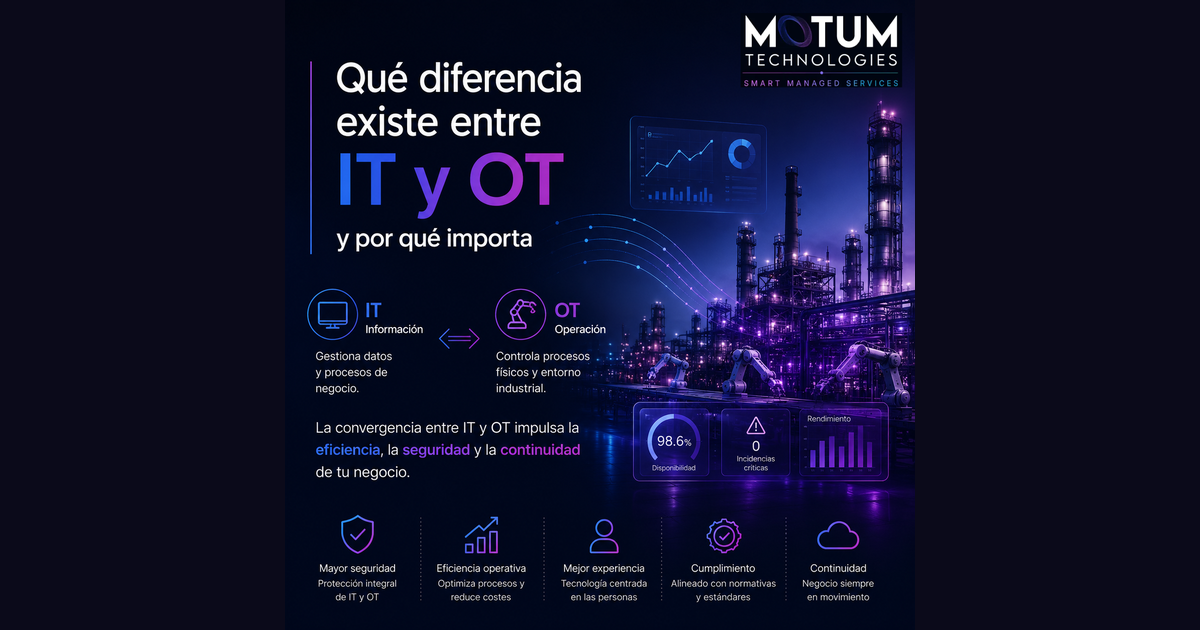 Motum Technologies ↗IT and OTDescubre qué diferencia existe entre IT y OT, por qué su convergencia es clave para la Industria 4.0 y cómo mejorar la seguridad, eficiencia y continuidad de los entornos críticos.
qué es IT
qué es OT
Operational Technology
Information Technology
convergencia IT OT
integración IT OT
Industria 4.0
ciberseguridad OT
infraestructura IT
infraestructura OT
Smart Managed Services
infraestructuras críticas
automatización industrial
transformación digital industrial
monitorización industrial
continuidad del negocio
IIoT
sistemas SCADA
PLC industrial
OT Security
IT
OT
Operational Technology
Information Technology
IT/OT Convergence
Industria 4.0
Industrial Internet of Things
IIoT
SCADA
PLC
Infraestructuras críticas
Ciberseguridad Industrial
Smart Managed Services
Continuidad Operativa
Edge Computing
Data Lake
Monitorización
Digitalización Industrial
Motum Technologies