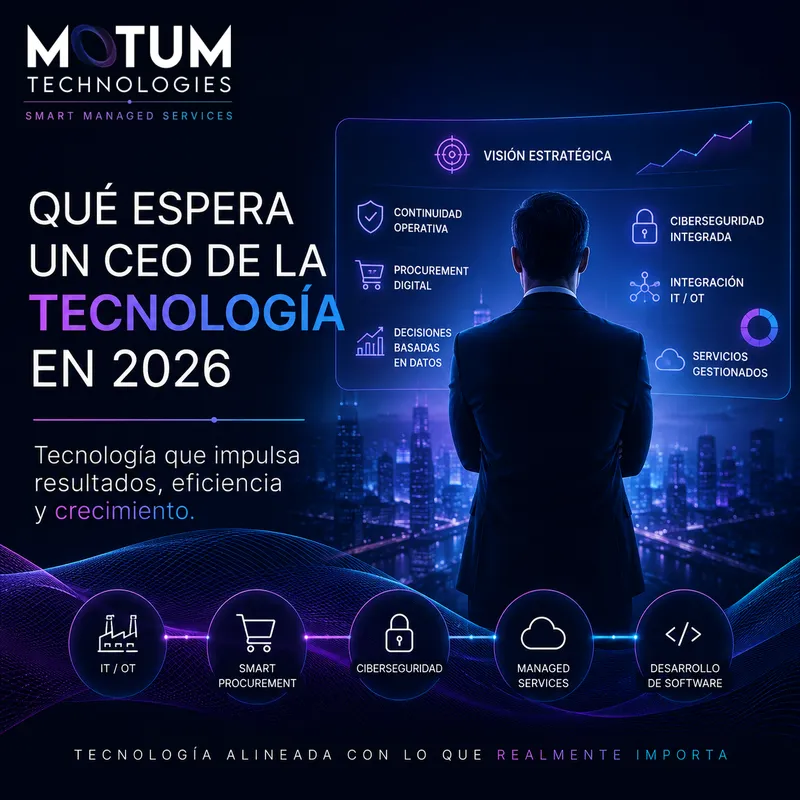
What a CEO Expects from Technology in 2026
Technology occupies a curious place in companies. It was indispensable, but rarely did it take center stage in strategic conversations. Discussions revolved around servers, networks, software, or infrastructures like one talks about electricity: a necessary element for everything to work, but far removed from major business decisions.
That has changed.
In 2026, CEOs no longer ask what technology they should incorporate. They ask how it can help them grow, protect the business, or be more competitive. The conversation has shifted from tools to results. And this change in perspective is redefining how organizations invest, manage, and understand technology.
Digitization is no longer about implementing solutions. It's about building more resilient companies.
Technology Stops Being a Cost to Become a Competitive Advantage
Economic uncertainty, technological acceleration, increased cybersecurity threats, and increasingly demanding markets have led to a profound change in the priorities of executive teams.
Today, a CEO does not expect the tech department to "keep the lights on." They expect it to contribute directly to company objectives.
Every tech decision must answer a very simple question: how does this help the business?
It doesn't matter if we're talking about artificial intelligence, automation, connectivity, software development, or infrastructure. The conversation no longer revolves around innovation for its own sake, but its ability to generate efficiency, reduce risks, optimize costs, or improve the experience of customers and employees.
In a way, technology has reached maturity. It has stopped chasing headlines to start solving real problems.
Business Continuity Has Become the Top Priority
There's a word that appears more and more frequently on board agendas: continuity.
Companies today depend on technology much more than they often realize. An incident in an industrial plant, a communication failure, a system disruption, or a cyberattack no longer only affects the IT department. They can shut down a factory, paralyze a supply chain, or prevent a hospital from continuing to provide service.
That's why the conversation has stopped being reactive.
It's no longer enough to resolve incidents when they arise. CEOs expect organizations capable of anticipating them.
This implies constant monitoring, having specialized teams that act before the problem occurs, and designing infrastructures designed to withstand even when circumstances are unfavorable.
Technology, ultimately, must become an element that brings peace of mind.
Fewer Vendors, More Comprehensive Vision
Another trend consolidating in 2026 has little to do with technology and much to do with management.
For years, many organizations have been adding specialized vendors to address specific needs. One managed communications, another infrastructure, another cybersecurity, another application development, and another support.
The result, too often, has been a complex ecosystem, difficult to coordinate and where it's hard to determine who's responsible when a problem arises.
Executive teams are starting to value a different approach.
They seek technological partners capable of understanding the organization as a whole, integrating different disciplines, and taking a global view of the operation. It's not just about reducing the number of vendors. It's about ensuring all technology responds to the same strategy.
This change explains the growth of models like Smart Managed Services, where infrastructure, connectivity, cybersecurity, support, software, and operations work as a single business-oriented system.
Data No Longer Impress. What Matters is What They Allow Us to Decide
Just a few years ago, it seemed enough to collect information.
Companies talked about Big Data, data lakes, and dashboards as if having millions of records was an end in itself.
Reality has finally imposed itself.
Today, practically every organization generates an enormous amount of information. What's truly differentiating is turning those data into quick and accurate decisions.
CEOs don't need more graphs. They need to know what's happening and what should be done next.
That's the real potential of technologies like artificial intelligence or advanced analytics. Not to replace the experience of executive teams, but to offer them more context to decide better and faster.
Digital Procurement Stops Being an Administrative Process
Few areas have evolved as much in recent years as procurement management.
Traditionally, procurement was associated with negotiating with vendors, issuing orders, or budget control. Today it plays a much more strategic role.
Every technological acquisition affects the security of the organization, growth capacity, system integration, and even operational continuity.
That's why digital procurement has shifted from focusing solely on buying better to buying more intelligently.
Automating processes, having up-to-date vendor information, controlling contracts, assessing risks, or unifying acquisition criteria allows for much more efficient and sustainable decisions in the long term.
It's no coincidence that the concept of smart procurement is gaining ground in companies looking to control costs without forgoing innovation.
Cybersecurity is No Longer Exclusively an IT Department's Concern
Perhaps one of the most significant changes this decade is how organizations understand security.
It's been a while since cybersecurity stopped being a technical issue.
Attacks no longer target only IT vulnerabilities. They aim to halt operations, affect corporate reputation, and threaten business continuity.
Regulations like NIS2 have helped accelerate this transformation, forcing many organizations to review not only their systems but also their processes, vendors, and governance models.
For a CEO, the question is no longer whether to invest in cybersecurity.
The question is how much it can cost not to do it.
Preparing for What Hasn't Arrived Yet
There's a common temptation in many organizations: designing infrastructure thinking only of current needs.
However, markets evolve too quickly to work with that logic.
Companies need architectures capable of growing, adapting, and evolving without having to rebuild the entire technological environment every few years.
Scalability, flexibility, and integration stop being concepts reserved for technical departments to become strategic requirements.
Those who design today thinking only of the present will probably have to start over sooner than anticipated.
Technology that Understands Business
Perhaps the greatest transformation isn't technological but cultural.
CEOs are no longer looking for vendors who know a specific product or manufacturer. They are looking for teams capable of understanding how their company works, what its risks are, and what it needs to keep growing.
That difference is crucial.
Because installing infrastructure is relatively simple.
What’s really complex is designing technology that accompanies the business's evolution over the next ten years.
And that requires combining technical knowledge with strategic vision.
The Future Belongs to Those Who Simplify Complexity
At a time when new technologies appear almost weekly, it might seem that success lies in incorporating more and more tools.
It's exactly the opposite.
Organizations that are responding best to this new scenario are those capable of simplifying. Those that integrate processes, eliminate silos, automate repetitive tasks, and turn technology into a facilitator, not an additional source of complexity.
This is probably the greatest challenge for any company in 2026.
Not having more technology.
But ensuring it all works in the same direction.
The Role of Motum Technologies
Organizations today need much more than a tech vendor. They need a partner who understands that every decision about infrastructure, connectivity, software development, procurement, cybersecurity, or managed services has a direct impact on the business.
That’s precisely the approach of Motum Technologies.
Their Smart Managed Services model integrates all these capabilities under a unique vision, aimed at improving efficiency, resilience, and operational continuity of organizations working in critical environments. From tech procurement management to IT and OT infrastructure operations, the goal is not to add complexity, but to reduce it.
Because, in the end, that's exactly what a CEO expects from technology in 2026.
Not for it to take up more space in the organization.
But to enable the organization to focus on what really matters: growing the business safely, efficiently, and confidently.
Frequently Asked Questions (FAQ)
What Does a CEO Look for When Investing in Technology in 2026?
They seek to improve profitability, reduce risks, ensure operational continuity, and have reliable information for strategic decision-making.
Why is Digital Procurement So Important for Companies?
Because it allows optimizing purchase management, reducing costs, controlling vendors, automating processes, and improving the traceability of all technological acquisitions.
What is the Difference Between Digital Procurement and Smart Procurement?
Digital procurement digitizes purchasing processes, while smart procurement incorporates automation, data analysis, and intelligence to optimize decisions and relationships with vendors.
What Advantages Do Smart Managed Services Offer?
They enable centralizing technology management, improving system availability, reducing incidents, optimizing costs, and ensuring continuous support for critical infrastructures.
How Does IT and OT Integration Help a Company?
It facilitates a unified view of the operation, improves efficiency, increases industrial safety, and enables decisions based on data from across the organization.
What Role Does Cybersecurity Play in Business Strategy?
Cybersecurity protects business continuity, reduces the impact of incidents, helps comply with regulations like NIS2, and strengthens the trust of customers, vendors, and shareholders.
How Can Motum Technologies Help an Organization?
Motum Technologies provides comprehensive Smart Managed Services solutions, connecting IT/OT infrastructure, technological procurement, software development, cybersecurity, connectivity, and managed services to improve efficiency, resilience, and competitiveness of companies with critical environments.