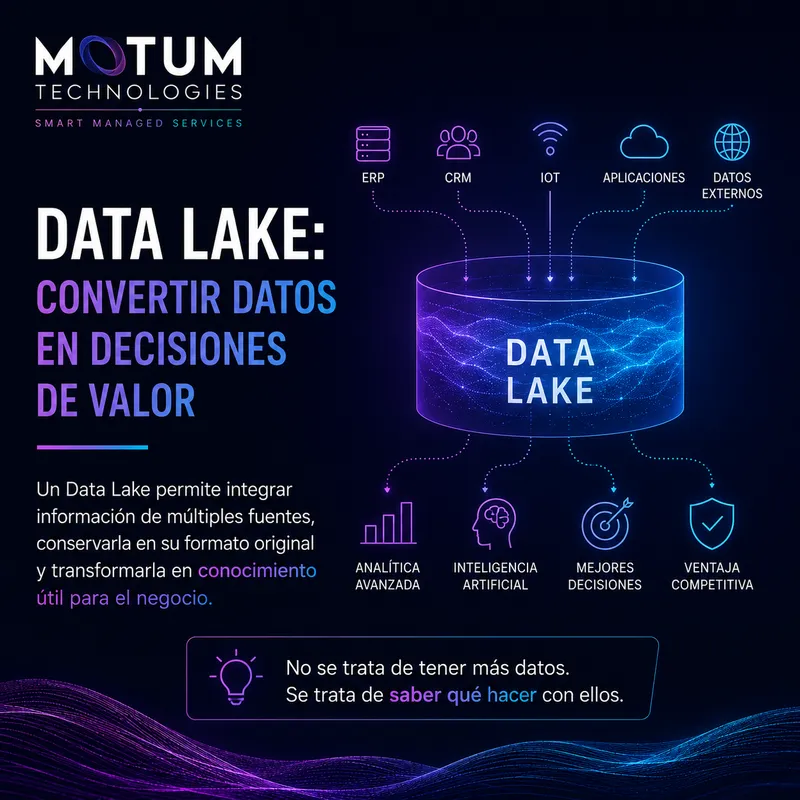
Every time a company adds a new digital tool, it also creates a new source of data. An ERP records financial activity, a CRM stores commercial relationships, an e-commerce platform captures customer behaviour, IoT sensors monitor industrial processes and corporate applications generate thousands of events every day. The result is a volume of information that grows constantly and that, in theory, should help make better decisions.
However, the reality is usually quite different.
Many organisations have more data than ever, yet struggle to answer relatively simple questions about their business. Information stays spread across multiple systems, each department works with its own tools, and getting an overall view means manually combining data from different applications.
The problem is no longer storing information. The real challenge is turning it into knowledge.
That is exactly where the Data Lake comes in: an architecture designed to centralise large volumes of data and turn it into a strategic asset for the organisation. But one idea should be clear from the start: implementing a Data Lake is not about piling up information indiscriminately. Its value lies in creating the conditions for data to be connected, enriched and turned into business decisions.
Much more than a data store
When people talk about a Data Lake, they usually think of a large repository for storing information. The definition is not wrong, but it is clearly incomplete.
The main difference from a traditional Data Warehouse is that a Data Lake keeps data in its original format. It does not need to be transformed or structured before being added to the system, which gives enormous flexibility when integrating new sources of information.
This means a single platform can bring together data from corporate databases, JSON or XML files, PDF documents, images, videos, industrial sensor logs or information generated by cloud applications. All of it lives within an architecture ready to evolve as the company does.
That adaptability is especially valuable in organisations that frequently add new applications or work with very heterogeneous technology environments.
However, it is important not to lose sight of the goal. A Data Lake does not add value simply because it stores more information. It does so when it makes it easier to use that data intelligently.
The real challenge is not generating data, but connecting it
Practically every modern organisation runs dozens of different applications.
Finance works with an ERP. The sales team uses a CRM. Production has its own systems. Marketing analyses digital campaigns while HR uses completely different tools. On top of that come bespoke applications, SaaS platforms, IoT solutions and cloud services.
Each of these systems offers a partial view of the company.
The problem appears when questions arise that affect several areas of the business. Which campaigns really bring in the most profitable customers? How does logistics affect customer satisfaction? What explains the increase in certain incidents? Which indicators can anticipate customer churn?
Answering these questions requires connecting information from multiple sources.
A Data Lake exists precisely to make that integration easier.
By bringing all that data together in a common architecture, the organisation stops analysing isolated departments and starts understanding how the business really works as a whole.
Without data quality there is no business intelligence
There is a fairly widespread idea that implementing a Data Lake will automatically solve information problems. It is a common mistake.
A data architecture will never be better than the quality of the information it receives.
If systems contain duplicate records, inconsistent values, capture errors or incomplete information, the Data Lake will simply store those same problems on a larger scale.
That is why truly successful projects do not start by talking about technology. They start by talking about data governance.
Ensuring information is consistent, identifying the origin of each record, standardising formats and setting validation criteria is far more important than deciding which technology platform to use.
In analytics, one statement remains completely valid: the quality of decisions will never be higher than the quality of the data they are based on.
The importance of bringing information in properly
Just as important as storing data is having a reliable mechanism to get it into the Data Lake.
This process, known as data ingestion or acquisition, often goes unnoticed, but it largely determines the success of the project.
Each organisation works with a different mix of information sources: business applications, databases, cloud platforms, APIs, IoT devices, spreadsheets or systems built specifically for its activity.
The key is to get all that information in automatically, keeping its context and preserving traceability throughout the process.
Knowing when a piece of data was generated, which system it came from and what transformations it has undergone is as important as the content itself.
Without that traceability, trust in the information wears away over time.
Value appears when data starts talking to other data
There is a phrase often used in analytics projects that perfectly sums up the purpose of a Data Lake: storing data does not generate knowledge.
The real potential appears when information can be connected.
Think of a company that combines sales data with commercial activity, logistics times, incidents logged by customer service and marketing campaigns.
Each system, on its own, explains only part of the picture.
When all that information is analysed together, patterns start to emerge that were previously hidden. It becomes possible to identify which customers are most likely to buy, understand which processes create inefficiencies, discover which products are really the most profitable or anticipate risks before they become problems.
It is precisely this ability to generate new knowledge that turns a Data Lake into a strategic asset.
Data stops describing what has happened and starts helping decide what should happen next.
Does every company need a Data Lake?
The short answer is no.
As with any technology, implementing one only makes sense when it responds to a real business need.
A small company working with a single management application will probably get better results with much simpler solutions.
However, the picture changes when the organisation starts to grow, adds new systems or needs to analyse information from different areas.
It is also especially interesting when the company wants to develop artificial intelligence projects, predictive models or advanced analytics, as all these initiatives need large volumes of well-organised historical information.
More than a question of size, the decision depends on how complex the organisation is and how much importance it gives to data as a strategic asset.
The risk of turning a Data Lake into a Data Swamp
Not every project achieves the expected results.
One of the most common mistakes is to store information without setting criteria for organisation, quality or governance.
When this happens, what many specialists call a Data Swamp appears: a huge repository with millions of records in which finding the right information becomes harder and harder.
Far from making work easier, the system ends up becoming an additional source of complexity.
Avoiding this scenario means defining clear policies from the start on data quality, metadata, information catalogues, access permissions and validation processes.
In other words, a Data Lake needs order as much as it needs storage capacity.
From data to decision
There is a common tendency in many technology projects to measure success by the implementation of the tool.
With Data Lakes it is exactly the opposite.
The goal should never be to build a data repository.
Real success means getting information to help make better decisions.
When business managers can access reliable data, connect information from different departments and analyse indicators practically in real time, the organisation becomes better able to anticipate change, spot opportunities and respond faster.
At that point data stops being a by-product of day-to-day activity and becomes a competitive advantage.
The role of Motum Technologies
Building an effective data strategy goes far beyond deploying a technology platform. It requires understanding how information flows within the organisation, integrating systems that have traditionally worked in isolation and ensuring data is reliable, accessible and useful for the business.
At Motum Technologies we help organisations tackle that process from a comprehensive perspective. We design data architectures built to grow, connect information from multiple systems, automate data acquisition and transformation processes, and integrate these capabilities into a technology strategy aligned with business goals.
Because a Data Lake, on its own, does not transform a company.
What really makes the difference is the ability to turn data into better-informed decisions. And in an environment where information has become one of any organisation's most valuable assets, that ability will be increasingly decisive for competing.
Frequently asked questions about Data Lakes
What is a Data Lake?
A Data Lake is a storage architecture designed to centralise large volumes of data from multiple sources, keeping it in its original format. Unlike a Data Warehouse, it does not require information to be structured before it is stored, which makes it easier to bring data from ERP, CRM, cloud applications, IoT sensors, databases, documents or images into a single environment ready for analysis.
What is a Data Lake used for?
A Data Lake brings together all of an organisation's information so it can be analysed as a whole, revealing patterns, generating knowledge and supporting data-driven decisions. It is also the technology foundation for Business Intelligence, Artificial Intelligence, Machine Learning and advanced analytics projects.
What is the difference between a Data Lake and a Data Warehouse?
The main difference is that a Data Warehouse stores data that has already been structured and transformed, while a Data Lake keeps data raw or in its original format. This makes the Data Lake a much more flexible solution for organisations that handle multiple information sources or large volumes of heterogeneous data.
When does it make sense to implement a Data Lake?
Implementing a Data Lake is especially recommended when a company works with many systems (ERP, CRM, cloud platforms, IoT or in-house applications), needs to analyse information across departments or wants to develop Artificial Intelligence, predictive modelling or advanced analytics initiatives.
Does every company need a Data Lake?
No. Small organisations with few information systems can meet their needs with simpler solutions. A Data Lake adds the most value in companies with complex processes, multiple data sources or a strategy focused on turning information into a competitive asset.
What types of data can a Data Lake store?
A Data Lake can store practically any type of information, including relational databases, CSV, JSON and XML files, PDF documents, images, videos, IoT sensor logs, SaaS applications, logs, industrial data and information from cloud services.
What advantages does a Data Lake offer over keeping data separate?
Centralising information removes data silos, connects information from different departments, improves the quality of analysis, speeds up reporting and supports faster, better-founded decisions. It also simplifies future automation and Artificial Intelligence projects.
What are the risks of implementing a Data Lake?
The main risk is storing information without a strategy for data quality, organisation and governance. When this happens, the Data Lake can turn into a Data Swamp, a disorganised repository in which finding useful information becomes harder and harder.
How important is data quality?
Data quality is one of the most important factors for the success of any analytics project. If the data contains errors, duplicates or inconsistencies, the conclusions drawn from it will also be unreliable. That is why data governance must be part of the project from the start.
How are a Data Lake and Artificial Intelligence related?
Artificial Intelligence models need large amounts of reliable, historical and well-organised data to be trained properly. A Data Lake makes that information available in one place, making it a key piece for generative AI, Machine Learning, predictive analytics and intelligent automation projects.
How is data brought into a Data Lake?
Information arrives through automatic data ingestion processes that connect business applications, APIs, databases, cloud systems, IoT sensors and other information sources. During this process it is essential to maintain traceability and know the origin of each piece of data to guarantee its reliability.
What role can Motum Technologies play in a Data Lake project?
Motum Technologies helps organisations design scalable data architectures, integrate information from multiple systems, automate data acquisition and transformation, and implement strategies that turn data into business decisions faster and more reliably.
Manuel Cantón. Head of R&D&I at Motum Technologies.