
For a long time, the purchasing department sat quietly in the background of organisations. For many executives, its role was limited to requesting quotes, negotiating discounts, issuing orders and making sure suppliers met the agreed deadlines. It was a necessary area, yes, but hardly seen as a driver of the business.
However, that perception has changed radically.
Digital transformation, globalised supply chains, growing technological complexity and the risks of an increasingly uncertain economic environment have turned purchasing into a strategic discipline. Today, the way a company selects its suppliers, manages its acquisitions or plans its technology investments directly influences its competitiveness.
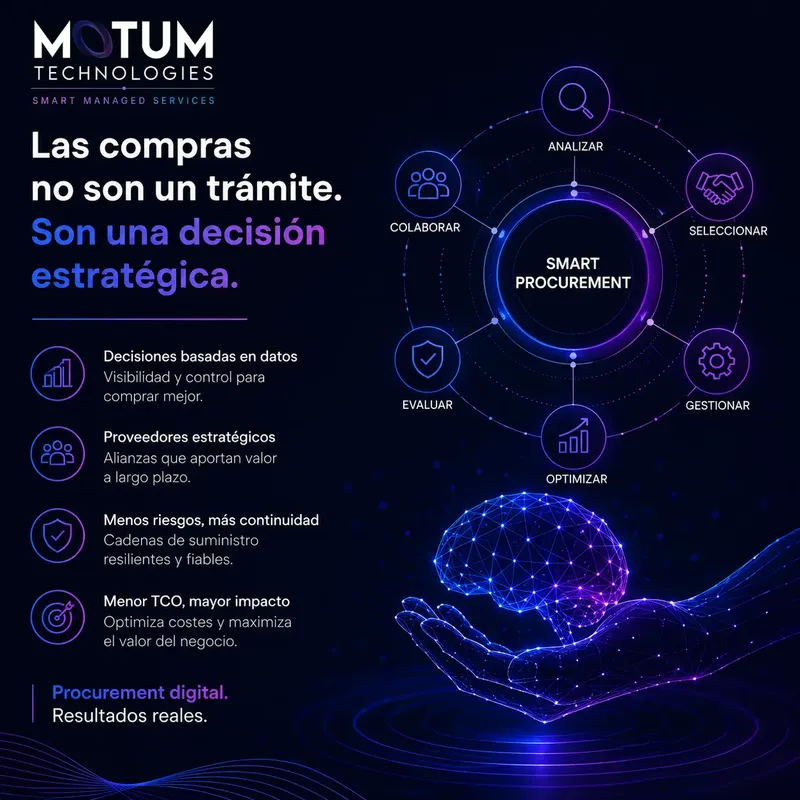
It is no coincidence that many companies no longer talk simply about "purchasing" and have adopted concepts such as Strategic Procurement or Smart Procurement. The change in terminology reflects a much deeper reality: buying is no longer just about cutting costs, but about creating value.
When price stops being the most important factor
There is a widespread idea that a good purchase is one that gets the lowest price. Although cutting costs is still a legitimate goal, basing the decision on that criterion alone can end up being far more expensive.
Just think about any technology project. Two servers may have a very similar price on paper but offer completely different levels of support. Two connectivity providers may make similar offers, yet only one has 24x7 response capability. Two cybersecurity solutions may appear to do the same job, but one integrates perfectly with the existing infrastructure while the other causes compatibility problems for years.
In these cases, the initial price is only a small part of the investment.
What really determines the return is the total cost over the solution's whole life cycle. In procurement this is known as Total Cost of Ownership (TCO): a view that includes maintenance, support, energy consumption, training, updates, availability of spare parts, scalability, operational risk and service continuity.
The most mature organisations have understood that savings do not always come from buying cheaper. Often they come from buying better.
Procurement as a tool to reduce risk
Recent years have shown that supply chains are much more vulnerable than they seemed.
The pandemic, the global shortage of electronic components, geopolitical tensions and logistics problems made it clear that depending on a single manufacturer or an ill-prepared supplier can bring entire projects to a halt.
In sectors where technology supports critical processes, such as industry, energy, healthcare, transport or retail, a supply interruption can mean financial losses, contractual breaches and even risks to the continuity of operations.
That is why modern procurement takes into account variables that were barely considered a decade ago.
Today, organisations analyse their suppliers' financial stability, logistics capacity, the proximity of support centres, stock availability, quality certifications, cybersecurity policies and regulatory compliance.
Buying stops being a transaction and becomes a risk management decision.
Digitalisation has also transformed purchasing
Just as digitalisation has changed production, sales and marketing, it is also revolutionising the way companies manage their acquisitions.
Many organisations still run processes based on spreadsheets, endless email chains and manual approvals that take up time and make budget control difficult.
Digital procurement aims precisely to eliminate these inefficiencies.
Specialised platforms centralise the whole purchasing process, automate approval flows, track budgets in real time, approve suppliers, evaluate their performance and provide full traceability from the initial request to the receipt of the product or service.
But perhaps the most important change is not automation, but the ability to make data-driven decisions.
With consolidated information it is much easier to spot savings opportunities, identify duplicate purchases, negotiate better terms with strategic suppliers or anticipate future investment needs.
Purchasing management stops relying on intuition and starts relying on evidence.
Smart Procurement: buying with a business mindset
Talking about Smart Procurement does not simply mean using digital tools.
The concept refers to a different way of understanding purchasing. A view in which technology, processes, market knowledge and business goals work together.
Instead of reacting when a need arises, procurement takes part from the early stages of projects.
It works with technology to define sustainable architectures. It works with operations to anticipate future capacity needs. It coordinates with finance to optimise investments and supports management in strategic planning.
In short, it stops being a support department and becomes an internal partner that brings knowledge and reduces uncertainty.
This shift is especially relevant in IT and OT infrastructure projects, where purchasing decisions shape the organisation's technology evolution for many years.
The right supplier brings much more than a product
One of the most common mistakes is to assume that all suppliers offer exactly the same thing.
Reality shows the opposite.
A good technology partner does not just deliver equipment or licences. It understands the customer's operating environment, knows the limitations of its infrastructure, anticipates incidents and proposes continuous improvements.
In complex projects, that experience can save weeks of work, avoid integration errors or considerably reduce operational risk.
That is why more and more organisations value aspects that go beyond the product catalogue.
Advisory capability, sector experience, speed of response, international coverage, specialised support and the ability to offer managed services are factors that directly influence the success of a project.
Choosing a supplier stops being a purchasing decision and becomes a business decision.
Procurement and critical infrastructure
When a company operates critical infrastructure, the importance of procurement grows exponentially.
Hospitals, industrial plants, logistics operators, energy infrastructure and public administrations need to guarantee that their systems are always available.
In these environments, a bad purchasing decision can have consequences far beyond the budget.
A critical component out of stock, a supplier unable to offer immediate support or a technology solution with no room to grow can compromise operational continuity for years.
That is why procurement strategies in IT and OT environments usually include criteria related to resilience, technology standardisation, asset life cycle management, business continuity and supply chain security.
Buying well means protecting future operations.
Tail Spend: the great forgotten opportunity
There is one aspect of purchasing management that many organisations overlook and that can nevertheless be a significant opportunity for savings and efficiency: Tail Spend. The term refers to the high volume of low-value purchases made from a large number of different suppliers. Although each individual transaction has a small financial impact, together they usually account for a large share of annual spending and consume a disproportionate amount of time and administrative resources.
Lack of visibility, scattered suppliers, manual processes and the absence of consistent policies make Tail Spend a common source of inefficiency. Centralising these purchases, consolidating suppliers and automating their management cuts operating costs, improves budget control and frees the purchasing team to focus on initiatives of greater strategic value.
How Motum Technologies helps optimise Tail Spend
At Motum Technologies we help our clients turn Tail Spend management into a competitive advantage. Thanks to our technology sourcing capability, a wide network of leading manufacturers and partners and a comprehensive management model, we simplify the acquisition of assets of any type or category that are usually managed in a scattered way.
By consolidating suppliers, unifying purchasing processes and offering a single specialised point of contact, organisations reduce their administrative burden, improve the traceability of their acquisitions and optimise total cost of ownership (TCO). The result is a more efficient, better-controlled procurement model that is fully aligned with the technology and business strategy.
Buying well is also a strategic decision
Companies that still see purchasing as a purely administrative process risk losing an important competitive advantage.
Every acquisition decision shapes an organisation's technology evolution, capacity to innovate, operational continuity and financial efficiency.
That is why modern procurement must be part of the business strategy from the very beginning.
Digitalising purchasing management, using data to make decisions and working with technology partners that bring specialised knowledge are key steps to turn a traditionally operational area into a real engine of growth.
In a context where technology evolves rapidly and business continuity increasingly depends on the quality of decisions, buying stops being a formality.
It becomes a strategic investment.