
If you search online for how to transform a data centre, you will find dozens of well-structured guides. They cover methodologies, project phases, migration plans and best practices. They are useful and necessary.
But there is one reality that barely appears in those documents: what happens when that transformation has to be carried out while a plant keeps producing.
In an industrial environment there are no ideal scenarios. There are production lines that cannot stop, maintenance windows that change within minutes, multidisciplinary teams that must coordinate precisely and decisions that have to be made on the ground.
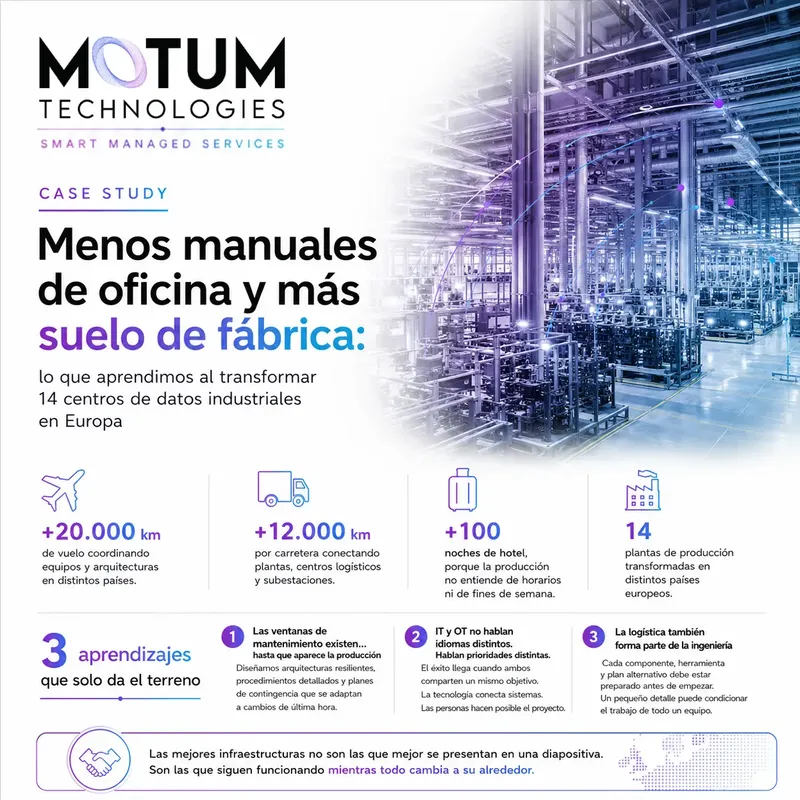
At MOTUM Technologies we have just completed the transformation of the infrastructure and data centres of 14 production plants across Europe. A project that took us thousands of kilometres, working side by side with plant teams, and confirmed that field experience is still the greatest asset in this kind of project.
A few figures help to put it in perspective:
More than 20,000 kilometres flown coordinating teams and architectures in different countries.
More than 12,000 kilometres by road connecting plants, logistics centres and substations.
More than 100 hotel nights, because production does not care about schedules or weekends.
But the real value of the project is not in the kilometres travelled, but in the lessons it leaves behind.
Three things you only learn when the project leaves PowerPoint and enters the factory
1. Maintenance windows exist... until production shows up
In corporate infrastructure it is possible to plan a shutdown weeks in advance.
In an industrial plant, the priority is always to produce.
That requires resilient architectures, extremely detailed procedures and contingency plans that can adapt to last-minute changes. Technology must fit into the operation, not the other way round.
2. IT and OT do not speak different languages. They have different priorities.
One of the biggest challenges in any industrial transformation is not technological, but human. IT teams look for availability, security and standardisation.
Operations teams need to make sure production continues without interruption.
Success comes when both stop working as separate departments and start sharing the same goal.
Technology connects systems. People make the project possible.
3. Logistics is also part of the engineering
When a rollout involves multiple plants spread across different countries, planning stops being an administrative task and becomes a critical part of the project.
Every tool, every component, every procedure and every fallback plan must be ready before the intervention starts.
Because, on the ground, a small detail can hold up the work of an entire team.
Experience cannot be improvised
Every project brings technical knowledge.
But it also teaches something more important: the difference between knowing a methodology and having applied it in real conditions.
Transforming critical infrastructure in industrial environments requires combining technology architecture, cybersecurity, automation, planning capability and constant communication with plant teams.
That balance can only be achieved by building up experience.
After travelling thousands of kilometres and completing this international project, we came back with an even firmer conviction: in industrial environments, technical excellence is essential, but trust is built on the ground.
Because the best infrastructures are not the ones that look best on a slide.
They are the ones that keep working while everything changes around them.