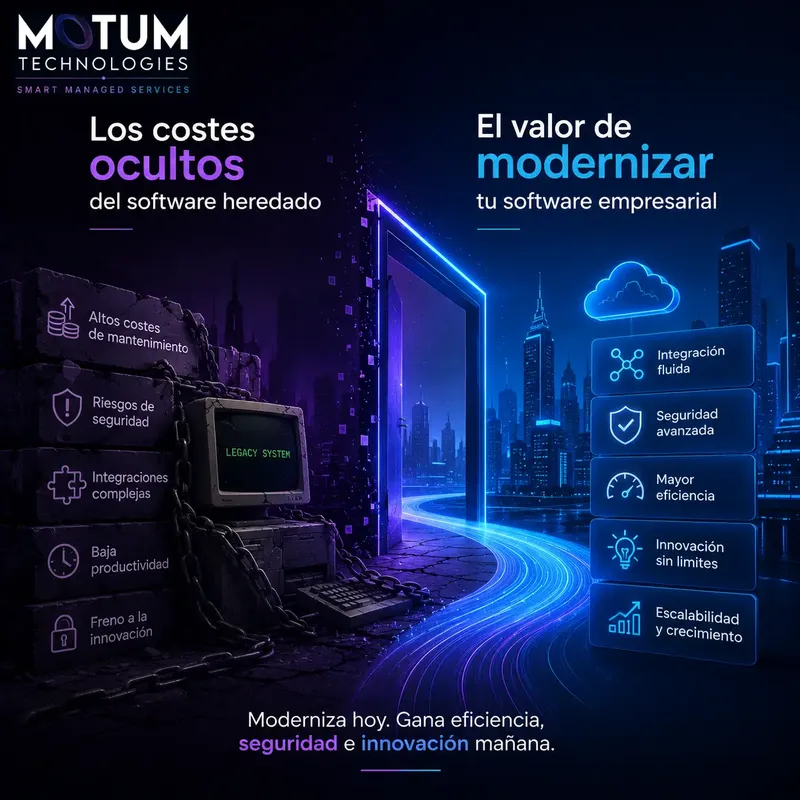
There's a phrase often heard in technology departments: "If it works, better not to touch it." For years it was almost a principle of caution. And, in certain contexts, it even made sense. Changing a critical application always involves investment, time, and a certain level of risk.
The problem is that this logic stops being valid when the cost of maintaining the system starts to exceed that of transforming it.
It's a much more common situation than it seems. Companies that have invested millions in digitization still rely on critical processes on applications developed fifteen or twenty years ago. Some are based on technologies that no longer receive support; others depend on a single person capable of modifying them; many were simply designed for a business that no longer exists.
Curiously, few organizations perceive this problem as an urgency. After all, the application still starts every morning.
However, the true cost of legacy software rarely appears on an invoice.
Software Doesn't Age, But the Company Does
There is an important difference between an old application and an obsolete application.
There are solutions developed over a decade ago that continue to be perfectly valid because they have evolved alongside the company. They have incorporated new features, improved their architecture, and adapted to business needs. The problem arises when the opposite occurs.
The organization grows, new processes arise, ways of working change, new regulations arrive, cloud tools, artificial intelligence or IoT platforms are incorporated... while the software remains exactly the same as the day it was implemented.
At that moment it stops being a tool and starts becoming a limitation.
It doesn't usually happen all at once. It's a slow wear and tear. Each new need demands a small development. Each integration costs more than expected. Each update is delayed because no one knows exactly what might break.
Over time, that sum of small inefficiencies ends up having a huge impact on the company's competitiveness.
The Most Expensive Cost Is Time
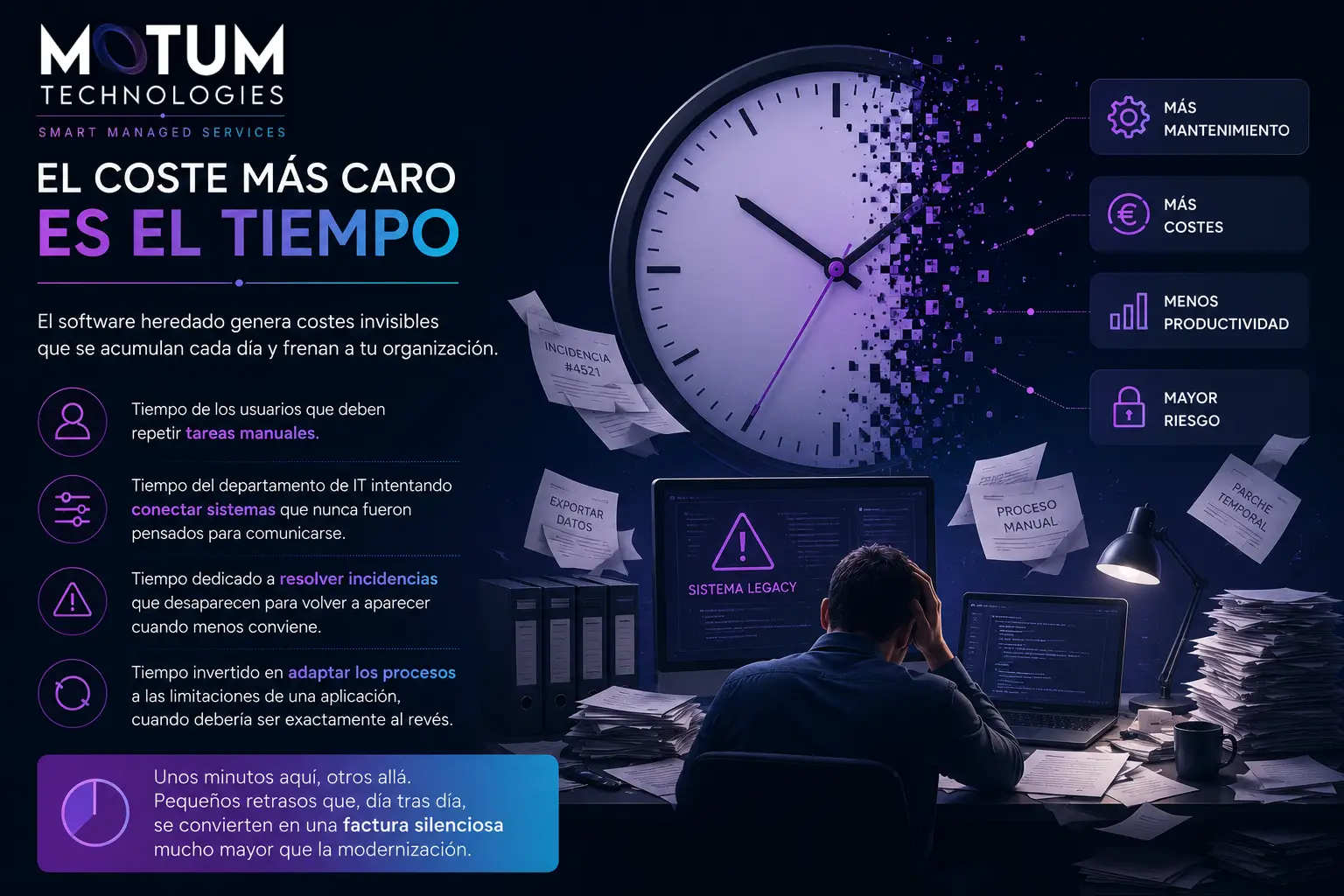
When talking about the cost of legacy software, maintenance, licenses, or support almost always come to mind. But those items represent only part of the problem. The really important expense is hidden in the time the organization loses:
User time that must repeat manual tasks.
IT department time trying to connect systems that were never intended to communicate.
Time spent resolving incidents that disappear for months only to reappear when least convenient.
Time invested in adapting business processes to the limitations of an application, when it should be exactly the opposite.
It's difficult to measure that impact because it appears spread across dozens of small daily delays. However, when analyzed with some perspective, many companies discover that they've been paying a much larger silent bill than the cost of modernizing their applications for years.
Innovation Has a Silent Enemy
Today practically all organizations talk about automation, artificial intelligence, advanced analytics, or process digitalization. But a prior question is rarely raised:
Is current technology ready to support that evolution?
It is common to find projects that fail even before they start because the company's main application doesn't have APIs, uses proprietary databases, or was developed on technologies that barely allow integrations. The usual consequence is not to cancel the project. The usual is to make it more expensive.
What initially seemed like a simple integration ends up becoming months of specific development, additional middleware, and provisional solutions that further increase the complexity of the technological ecosystem.
Paradoxically, many companies believe they are saving by not renewing their software, when in reality they are paying much more to keep it alive.
The Risk Nobody Includes in the Budget
There is another even less visible cost: Dependence.
Many organizations operate thanks to applications whose knowledge resides in a single person. It could be the developer who created them fifteen years ago, an external provider, or an internal technician who knows all the "patches" incorporated over time. As long as that person remains available, the risk seems non-existent. But a change of provider, retirement, or a critical incident is enough to discover that no one really understands how an essential part of the business works.
The same goes for cybersecurity.
Legacy applications are often based on components that stopped receiving support years ago. It is not only a technical issue. It also affects regulatory compliance, operational continuity, and, in certain sectors, the organization's own reputation.
Regulations like NIS2 are accelerating this change of mindset because they require looking beyond the security perimeter and analyzing the risk associated with the entire technological ecosystem.
Modernizing Doesn't Mean Starting From Scratch
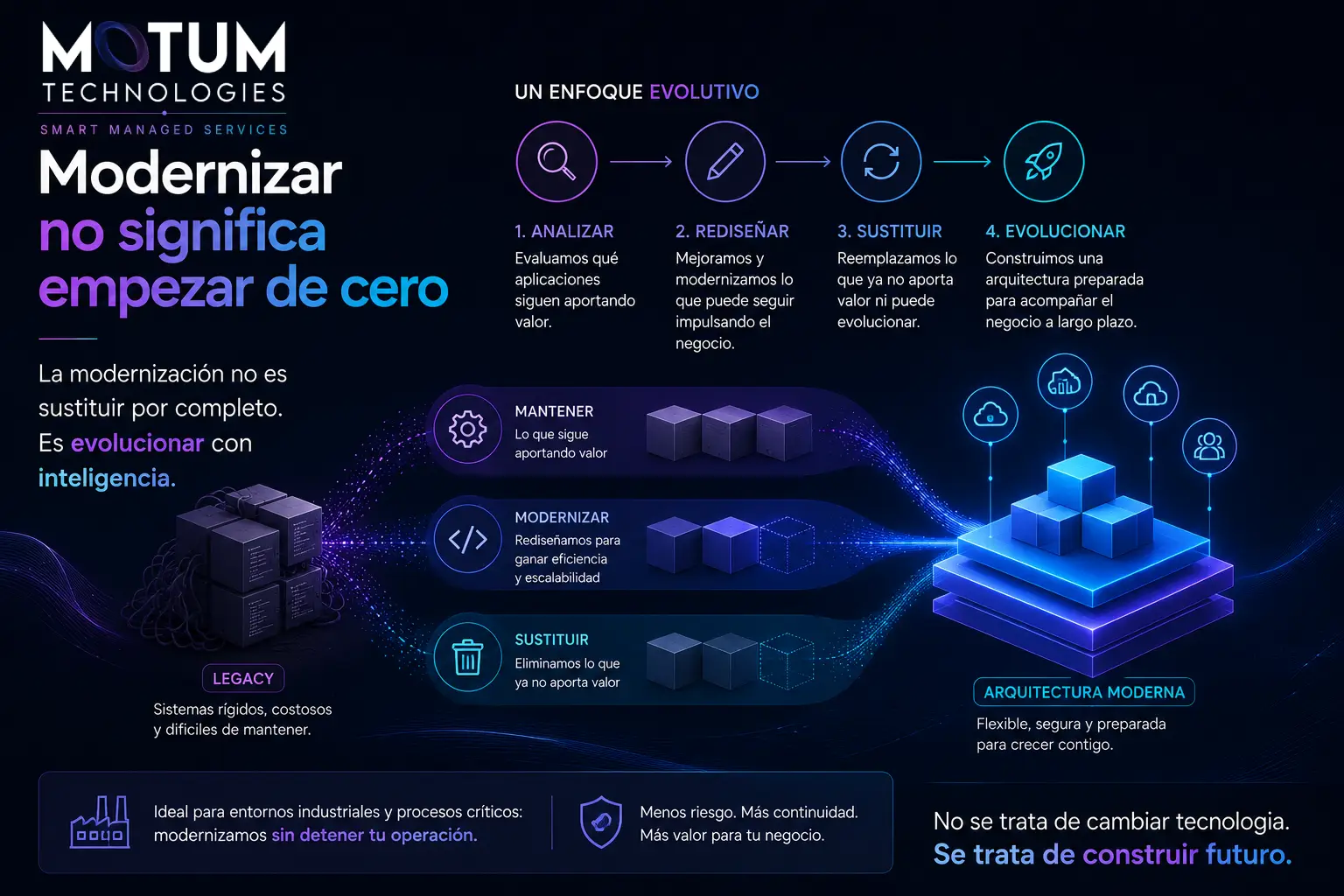
Perhaps one of the biggest mistakes is thinking that the only alternative is to completely replace existing software. Rarely is that the best option.
Experience shows that organizations get better results when they approach modernization as an evolutionary process. They analyze which applications continue to add value, which ones should be redesigned, and which are worth replacing entirely.
The goal is not to change technology for the sake of change.
It's about building an architecture capable of accompanying the business for the next ten years, not just the next ten months. This approach is especially important in industrial companies and organizations with critical processes, where stopping operations is never an option.
Technology at the Service of Business
At Motum Technologies we understand that custom software development is not just about writing code.
It's about understanding how an organization works, identifying where inefficiencies are generated, and designing business applications capable of eliminating those frictions without compromising business continuity.
Each project starts from a simple idea: technology should facilitate the company's growth, not become a barrier to it.
That's why we approach software modernization from a strategic perspective, combining development, systems integration, IT and OT environment knowledge, and a long-term vision that allows building scalable, secure, and prepared solutions for evolution.
Because the real problem with legacy software is not its age.
It's everything that it prevents from doing while it continues to occupy the center of the organization.
Frequently Asked Questions (FAQ)
What is legacy software?
It is any business application that continues to be used despite having been developed with old technologies, difficult to maintain or hardly compatible with current business needs.
How to know if my company needs to modernize an application?
Some common signs are high maintenance costs, difficulty integrating new systems, dependence on very specific knowledge, slowness in making changes, or cybersecurity risks.
Is it better to replace all software or modernize it progressively?
It depends on the state of each application. In many organizations, a gradual modernization that reduces risks and maintains business continuity is more efficient.
What advantages does custom software development offer?
It allows creating solutions tailored to the real processes of the company, improving integration with other systems, facilitating scalability, and reducing long-term operational costs.
Can legacy software affect cybersecurity?
Yes. Applications based on unsupported technologies often present vulnerabilities that increase the risk of cyberattacks and make compliance with regulations like NIS2 difficult.
How does Motum Technologies assist in these types of projects?
Motum Technologies analyzes the state of existing software, defines a modernization strategy tailored to each company, and develops secure, scalable business applications integrated with the rest of the technological ecosystem.