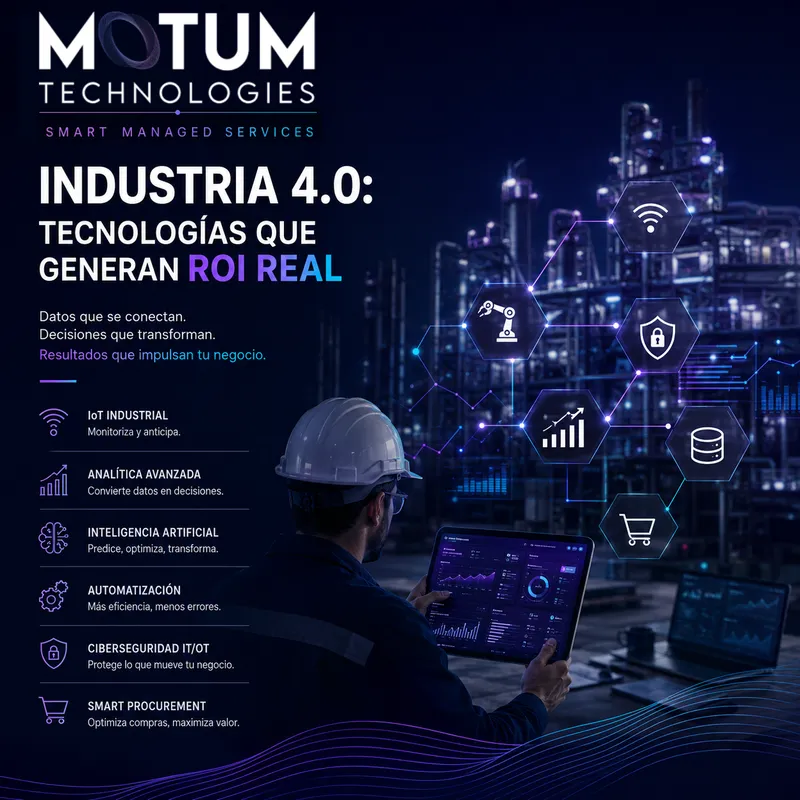
Industry 4.0 has been filling headlines, corporate presentations and strategic plans for more than a decade. Yet in many organisations one fundamental question remains: which technologies really deliver a return on investment (ROI), and which are simply trends with little impact on the business?
The answer matters even more in an economic climate where companies have to justify every euro invested in digitalisation. Adding technology is no longer enough; you need to show how it improves productivity, cuts costs, increases operational availability or creates new business opportunities.
The reality is that Industry 4.0 is not only about automation or digitalisation. Its real value lies in connecting operations, data and people to turn scattered information into faster, more accurate and more profitable decisions. That is exactly where the organisations getting the best results are focusing their investments.
In this article we look at the Industry 4.0 technologies that are proving tangible ROI in industrial, logistics, energy and corporate environments, and at the factors that determine whether these initiatives succeed or fail.
What do we really mean by Industry 4.0?
Industry 4.0 is the convergence of digital technologies and operational processes. Its goal is to create intelligent environments where machines, systems, applications and people share information in real time to improve decision-making.
Although it is usually associated with automated factories, its scope is much broader. Today we find Industry 4.0 projects in sectors such as:
Manufacturing.
Energy and utilities.
Transport and logistics.
Retail.
Healthcare and pharma.
Critical infrastructure.
Public administration.
The key is not the technology on its own, but its ability to improve specific business indicators: operational efficiency, fewer incidents, cost optimisation, regulatory compliance, traceability or user experience.
As in the projects carried out by Motum Technologies, the goal is not to deploy technology for its own sake, but to turn data and connectivity into real value for the organisation.
The problem with many digital transformation initiatives
One of the main mistakes organisations make is starting technology projects without first defining the problem they want to solve.
It is common to find significant investments in IoT sensors, analytics platforms or artificial intelligence tools that end up underused because clear success metrics were never set.
When that happens, technology becomes a cost.
When the project starts from a clearly defined business need, technology becomes an investment.
The most digitally mature organisations tend to ask questions such as:
How can we reduce downtime?
How can we lower operating costs?
How can we improve traceability?
How can we optimise purchasing and suppliers?
How can we make decisions based on data rather than intuition?
How can we guarantee operational continuity?
The right technology will depend on the answers to these questions.
Industrial IoT: one of the fastest ROIs
Of all the technologies associated with Industry 4.0, the Internet of Things (IoT) is still one of those that delivers the fastest and most measurable returns.
The way it works is simple: connected sensors collect information from physical assets and send it to central platforms for monitoring and analysis.
This makes it possible to know in real time things such as:
Temperature.
Energy consumption.
Vibration.
Asset location.
Machinery status.
Production variables.
ROI appears when this data makes it possible to act before an incident occurs.
A clear example is predictive maintenance. Detecting an anomaly in an industrial motor before it causes a breakdown can prevent production stoppages that cost thousands of euros per hour.
Logistics traceability is another especially relevant case. Motum has developed IoT solutions to monitor critical assets in real time, including traceability projects in nuclear medicine, where precision and safety are essential.
In these cases, the return does not come only from financial savings, but also from reducing operational and regulatory risk.
Data Lakes and advanced data exploitation
Many companies accumulate large volumes of information from ERPs, CRMs, SCADA systems, industrial sensors, corporate applications and external platforms.
The problem is that this data is usually siloed.
That is why data integration and exploitation projects are delivering some of the highest returns within Industry 4.0.
A Data Lake centralises information from multiple systems and turns it into a single source of knowledge.
When this information is properly structured, organisations can:
Identify inefficiencies.
Detect patterns.
Improve forecasts.
Optimise processes.
Automate decisions.
In industry, for example, unifying production, maintenance and quality data reveals bottlenecks that were previously hidden.
Motum has developed Data Lake Hub projects aimed precisely at unifying, normalising and exploiting data to produce advanced reporting and improve decision-making.
The return usually shows up in three main areas:
Higher productivity.
Less time spent on manual analysis.
Faster, more accurate decisions.
Artificial Intelligence applied to operations
Artificial Intelligence is at the centre of much of today's technology debate.
From a business perspective, however, the question is not whether an organisation should use AI, but where it creates real value.
The most profitable implementations are usually found in very specific scenarios:
Incident prediction
AI models can analyse large volumes of operational data to anticipate failures before they happen.
This reduces downtime and maintenance costs.
Inventory optimisation
AI improves demand forecasts and helps adjust stock levels.
In sectors with complex supply chains, the financial impact can be very significant.
Document automation
Automatic processing of documents, contracts, invoices or forms.
Organisations cut administrative time and human error.
Anomaly detection
AI identifies anomalous behaviour in networks, infrastructure or production processes.
This is especially relevant in critical IT/OT environments.
It is important to note, however, that AI on its own rarely generates a return.
Its effectiveness depends on data quality, integration with existing processes and the organisation's ability to act on the results.
Industrial cybersecurity: the ROI of avoiding losses
Cybersecurity has traditionally been seen as a necessary cost.
Yet more and more organisations see it as a strategic investment.
OT infrastructure has become a priority target for cybercrime.
An operational interruption caused by a security incident can lead to financial losses far greater than the cost of prevention.
The ROI of cybersecurity is not usually measured in revenue generated, but in losses avoided.
The most relevant benefits include:
Lower operational risk.
Regulatory compliance.
Protection of critical assets.
Business continuity.
Protection of corporate reputation.
That is why the most successful Industry 4.0 projects build cybersecurity in from the initial design rather than adding it later as an extra layer. Protecting IT/OT infrastructure is one of Motum's strategic pillars, alongside operational continuity and the intelligent use of data.
Process automation: fewer repetitive tasks, more productivity
Automation is still one of the most profitable technology investments.
When we talk about Industry 4.0 we do not only mean industrial robots.
Modern automation includes:
Document flows.
Administrative processes.
Incident management.
Provisioning.
Regulatory checks.
Integrations between systems.
ROI appears quickly because it removes repetitive tasks, reduces errors and frees up resources for higher-value activities.
A practical example is digitalising forms and field inspections.
Replacing paper-based manual processes with mobile apps and electronic signatures makes it possible to:
Cut administrative time.
Eliminate transcription errors.
Improve traceability.
Guarantee regulatory compliance.
The results are usually visible within a few months.
Smart Procurement: an underrated opportunity
When people talk about Industry 4.0, purchasing is rarely mentioned.
Yet for many organisations it represents one of the greatest potential sources of ROI.
Digitalising purchasing makes it possible to:
Centralise suppliers.
Negotiate better.
Cut costs.
Control risks.
Gain visibility over spending.
Smart Procurement models combine technology, analytics and processes to optimise the full purchasing cycle.
Motum has developed specific solutions in this area through Smart Procurement Proxy models designed to centralise, optimise and control corporate spending.
In organisations with multiple operating sites or a large number of suppliers, savings can reach very significant figures in the first year.
Cloud and hybrid infrastructure
Moving to the cloud is still a priority for many companies.
However, profitability depends on how it is implemented.
Moving systems to the cloud without reviewing processes or architecture rarely delivers benefits.
The organisations getting the best results use hybrid models that combine:
On-premises infrastructure.
Private cloud.
Public cloud.
Managed services.
This approach provides:
Scalability.
Flexibility.
Operational continuity.
Lower infrastructure costs.
Faster deployment.
It also makes it easier to integrate advanced technologies such as analytics, artificial intelligence or remote monitoring.
Monitoring and observability platforms
One of the common traits of the most efficient organisations is visibility.
You cannot optimise what you cannot measure.
Monitoring platforms make it possible to supervise in real time:
IT infrastructure.
Networks.
Applications.
Industrial systems.
Critical services.
The ROI comes from several sources:
Fewer incidents.
Faster resolution.
Higher availability.
Better user experience.
Smaller impact from interruptions.
In sectors where operational continuity is critical, even small improvements in availability can translate into major financial benefits.
How to calculate the ROI of an Industry 4.0 project
Although every organisation has its own particularities, there are common indicators for assessing the return.
Cost savings
Lower operating, energy or administrative expenses.
Higher productivity
Greater production capacity with the same resources.
Fewer incidents
Fewer interruptions and lower associated costs.
Time recovered
Hours freed up thanks to automation.
Regulatory compliance
Lower risk of penalties.
Quality of service
A better experience for customers and users.
The companies getting the best results usually set metrics before starting the project and track the indicators continuously.
The key is not the technology, but the strategy
Many organisations are still asking which technology they should implement.
The right question is a different one.
Which business problem do we want to solve?
Industry 4.0 technologies deliver ROI when they are aligned with specific goals of efficiency, operational continuity, security, traceability or value creation.
IoT, artificial intelligence, automation, advanced analytics, Smart Procurement or cybersecurity can deliver extraordinary returns, but only when they are part of a coherent, results-driven strategy.
Experience shows that the companies leading their digital transformation are not necessarily the ones that invest the most, but the ones that best connect technology and business.
That is exactly the approach that drives Motum Technologies: designing, deploying and managing IT/OT solutions that improve operational continuity, turn data into decisions and create tangible value for organisations.