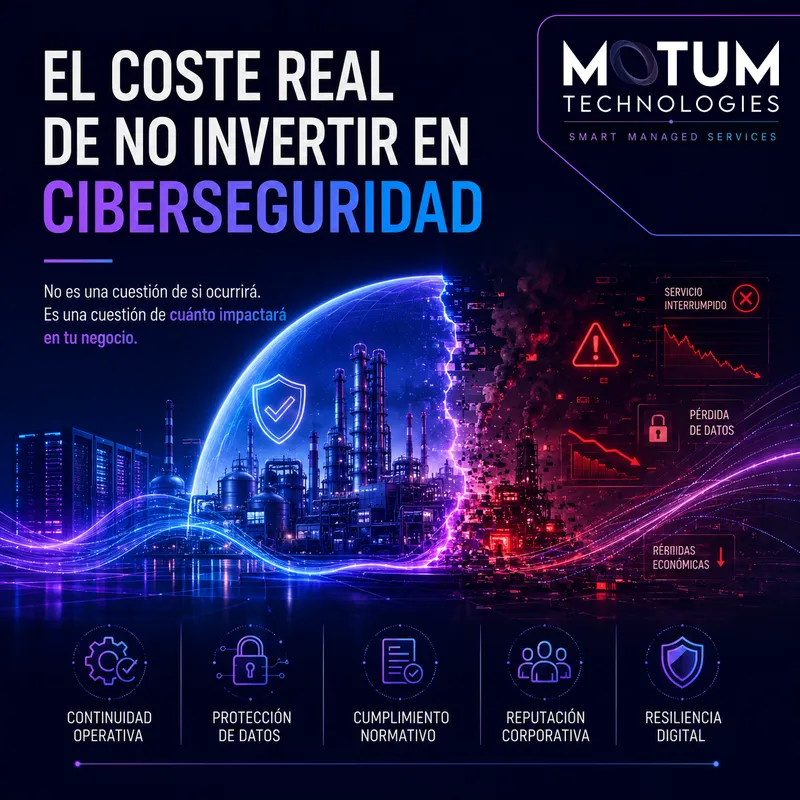
When savings turn into a million-euro bill
For years, many organisations have seen cybersecurity as a necessary but hard-to-justify expense. Unlike a new production line, an automation tool or a commercial investment, the benefits of IT security are not always visible in the short term. However, this perception is changing fast.
Digitalisation has transformed the way companies operate, communicate and create value. Today, information systems are as critical to the business as the machinery in an industrial plant, the sales network or the people themselves. And when these systems fail or are compromised, the consequences go far beyond a technology problem.
The reality is that the cost of not investing in cybersecurity is usually far higher than that of implementing a proper protection strategy. In fact, most companies do not discover the value of cybersecurity when they buy it, but when they need it and do not have it.
A false sense of security
One of the most common mistakes in small and medium-sized companies is to think that cybercriminals only attack large corporations.
Nothing could be further from the truth.
Today's attacks are highly automated. Cybercriminals do not pick their victims by hand; they use tools that scan the internet looking for vulnerabilities, unpatched systems, weak passwords or misconfigurations. A company with twenty employees can be as attractive as a multinational if it offers an easy way in.
In addition, many organisations assume that having an antivirus or a basic firewall is enough. Yet today's threat landscape is much more complex. Ransomware, advanced phishing, credential theft, supplier attacks, social engineering and data leaks are risks that require a comprehensive strategy and ongoing management.
The question is no longer whether a company will be the target of an attack attempt, but when it will happen and how well it will be able to respond.
The direct financial cost of an incident
When an organisation suffers a cyberattack, the first impact is usually financial.
In some cases the costs are immediate. Ransomware can paralyse activity for days or weeks. An intrusion can force entire systems to be restored. A data leak can lead to regulatory penalties or legal claims.
But even when the company manages to recover its operations, the bill keeps growing.
The most common direct costs include:
• Recovering systems and data.
• Urgently hiring incident response specialists.
• Replacing compromised equipment.
• Forensic audits.
• Notifying security breaches.
• Legal and regulatory costs.
• Higher insurance premiums.
• Lost contracts tied to security requirements.
In many cases, the total cost of recovery far exceeds the investment that would have been needed to prevent the incident.
It is like skipping the preventive maintenance of a critical infrastructure. What first looks like a saving ends up as a much more expensive repair.
The hidden cost: business interruption
There is one dimension of the problem that usually gets less attention but can be even more damaging: the interruption of activity.
When a company cannot access its systems, its email, its management applications or its production platforms, the business stops.
Employees lose productivity.
Customers do not get served.
Orders are delayed.
Projects come to a halt.
Sales stop.
In industrial, logistics or critical services sectors, a few hours of interruption can mean significant financial losses. In highly digitalised organisations, every minute of downtime has a direct impact on revenue and customer experience.
That is why cybersecurity can no longer be understood as just a technology issue. It is a discipline closely tied to business continuity.
Reputation also has a price
One of any company's most valuable assets is trust.
Customers, suppliers, partners and employees entrust sensitive information to corporate systems every day. When a security breach occurs, that trust can be seriously damaged.
Reputation is not usually lost all at once, but gradually.
A customer who receives a notice that their data has been compromised may start to question the company's ability to protect critical information.
A supplier may demand additional controls before sharing sensitive documentation.
A potential customer may rule out a commercial proposal after finding a history of security incidents.
In increasingly competitive markets, trust has become a differentiator. And rebuilding it usually takes far more time and resources than maintaining it.
Legal and regulatory consequences
Growing regulation on data protection and cybersecurity has considerably raised the legal risk associated with incidents.
Regulations such as the GDPR set clear obligations for managing and protecting personal information. In addition, new European directives such as NIS2 are extending organisations' responsibilities for digital resilience and risk management.
This means a security breach is no longer just a technical problem.
It can also become a legal, regulatory and corporate matter.
Financial penalties are only part of the problem. Regulatory investigations, extraordinary audits and additional compliance requirements can generate significant costs for months or even years.
For many organisations, especially those operating in regulated sectors or handling sensitive data, investing in cybersecurity is also an investment in regulatory compliance.
The impact on the supply chain
Companies no longer operate in isolation.
They are part of digital ecosystems where suppliers, customers, technology partners and external platforms exchange information continuously.
This has brought an important change in risk management.
Today, an organisation can become a target not because of its own value, but because of its relationship with other companies.
Supply chain attacks are becoming more frequent because they give access to multiple organisations through a single vulnerable point.
That is why more and more companies demand security guarantees from their technology suppliers.
Having a solid cybersecurity strategy is no longer just a matter of internal protection. It also directly influences the ability to take part in high-value projects, tenders and business relationships.
The cost of data loss
Information is one of any organisation's most important assets.
Customer databases, technical documentation, industrial designs, financial information, contracts, intellectual property and operational know-how are the core of the business.
When this data is lost or becomes inaccessible, the impact can be devastating.
Some losses can be recovered with proper backups.
Others cannot.
The loss of historical information, unauthorised access to strategic data or the theft of intellectual property can have consequences that last for years.
In certain sectors, the real value of information far exceeds the value of the company's physical assets.
That is why protecting data has become a strategic priority.
Cybersecurity and business competitiveness
Security was traditionally seen as a defensive function.
Today, the most advanced organisations see it as a competitive advantage.
More and more customers include cybersecurity requirements in their supplier selection processes.
Third-party audits are commonplace.
Security certifications build trust.
The ability to demonstrate technology resilience has become a differentiator.
A company that can guarantee the availability of its systems, the protection of its data and operational continuity projects an image of maturity and professionalism above that of its competitors.
From this perspective, cybersecurity stops being a cost centre and becomes a business enabler.
How much should a company invest?
This is one of the most frequent questions.
The right answer is not a specific figure, but a risk assessment.
Not all organisations have the same needs.
The level of investment will depend on factors such as:
• Company size.
• Volume of information handled.
• Dependence on technology.
• Level of exposure to the internet.
• Regulatory requirements.
• Criticality of operations.
• Risk associated with the sector.
What really matters is understanding that the investment must be proportional to the potential impact of an incident.
Many companies spend more recovering from an attack than they would have spent preventing it.
That is why the most effective strategies usually combine technology, processes, training and continuous monitoring.
Security is not a product you buy once. It is an ongoing process of risk management.
The importance of a comprehensive approach
One of the most common mistakes is to build the whole strategy around technology tools.
However, most security incidents have a human component.
An employee who clicks on a fraudulent email.
A reused password.
Overly permissive access.
A misconfiguration.
That is why modern cybersecurity must be approached from a global perspective that combines people, processes and technology.
The most resilient organisations are those that build security into all their operations, from the technology infrastructure to user management, staff training and business continuity plans.
Effective protection requires visibility, monitoring, response capability and continuous improvement.
Cybersecurity as a strategic investment
For a long time, companies have tried to calculate the return on cybersecurity investment by asking how much profit it generates.
Perhaps the right question is a different one:
How much could it cost not to have it?
The answer includes financial losses, operational interruptions, reputational damage, regulatory breaches, lost customers and reduced competitiveness.
In an environment where digitalisation is moving fast, cybersecurity has become essential to guarantee business continuity and growth.
Organisations that understand this reality do not wait to suffer an incident before acting. They invest in prevention, resilience and response capability because they know that protecting the business is also a way of driving it forward.
Conclusion
Digital transformation has greatly expanded the opportunities for companies, but it has also increased their exposure to ever more sophisticated risks.
The question is no longer whether cybersecurity is worth the investment, but whether an organisation can afford to operate without it.
The real cost of not investing in cybersecurity rarely appears in annual budgets. It shows up when systems stop working, when data disappears, when customers lose trust or when a company discovers that a technology problem has turned into a business crisis.
At Motum we see cybersecurity as an essential part of any organisation's technology strategy. It is not just about protecting infrastructure or devices, but about guaranteeing the operational continuity, digital resilience and growth capacity of companies in an increasingly connected environment.
Because in today's digital economy, the best investment in cybersecurity is not the one made after an incident. It is the one that stops it from happening.
FAQ
What happens if a company does not invest in cybersecurity?
A company can suffer financial losses, operational interruptions, data theft, regulatory penalties and reputational damage.
How much does a cyberattack cost a company?
The cost depends on the size of the organisation and the impact of the incident, but it can include lost revenue, system recovery, legal costs and lost customers.
Is cybersecurity an expense or an investment?
Cybersecurity should be seen as a strategic investment because it protects digital assets, operational continuity and corporate reputation.
Which companies need cybersecurity?
All companies, regardless of their size or sector, are exposed to digital threats and need appropriate protection measures.
How can a company improve its cybersecurity?
Through regular audits, continuous monitoring, employee training, infrastructure protection and incident response plans.