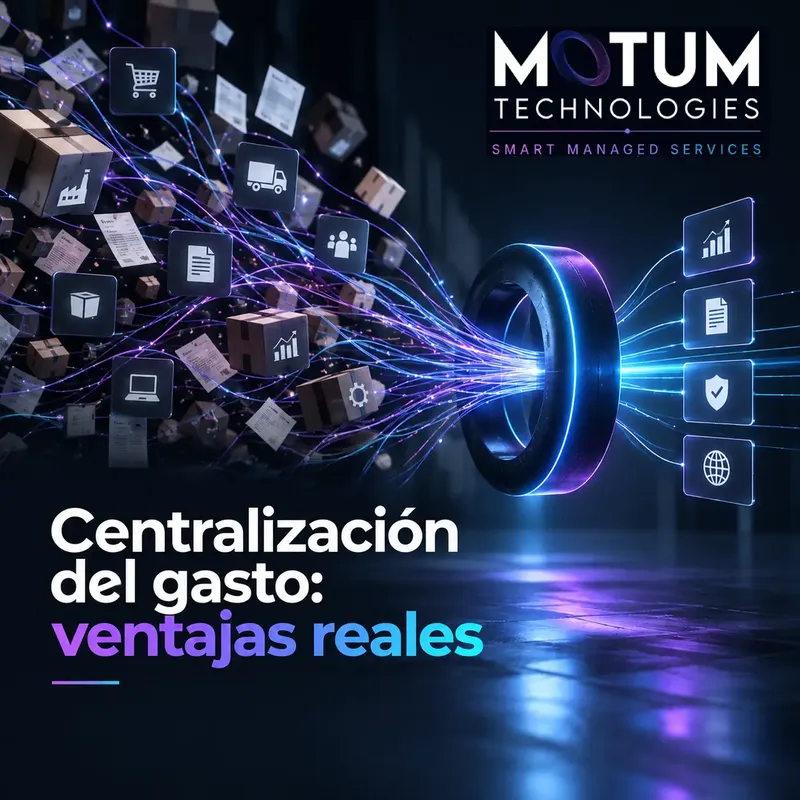

Many companies have grown in a much more organic way than their organizational charts reflect. New branches open, business units appear, production plants are incorporated, other companies are acquired, or each department simply acquires the resources it needs to keep working. The result can be a perfectly functional organization and, at the same time, surprisingly fragmented when viewed from the perspective of expenditure.
Finance knows the budget. Purchasing has its usual suppliers. IT controls part of the licenses and technological equipment. Operations work with specialized distributors. Each plant maintains historical relationships with certain suppliers and, meanwhile, small purchases appear made directly by different departments.
Everything works. Until someone asks a seemingly simple question: How much are we really buying, from whom, and under what conditions?
Answering precisely is not always easy.
Centralizing expenditure aims to solve precisely that problem. But it's important to clarify something from the beginning: centralizing does not necessarily mean that all purchases of a company have to go through a single person, nor does it mean turning procurement into a bottleneck. It also does not mean eliminating the autonomy of local teams.
Properly planned, centralization mainly aims to allow an organization to see, understand, and manage its expenditure as a whole, even if certain purchases continue to be distributed.
And that difference is important.
The problem is not buying in a decentralized way. It is not knowing that we are doing it.
In a company with a single office, few suppliers, and a simple structure, maintaining a global view of expenditure is relatively easy. The situation changes as complexity increases.
Imagine an industrial group with different plants. One acquires network switches from a local distributor; another buys similar equipment through an integrator; headquarters has a corporate contract with a third supplier; and a fourth plant places occasional orders when an urgent need arises.
Probably all these purchases are justified. The problem arises when no one has a joint view.
According to CIPS, spend analysis precisely starts with collecting, classifying, and analyzing purchasing data to gain visibility on costs, compliance, and improvement opportunities. Consolidating this information allows understanding expenditure on a corporate scale and using it to guide procurement decisions.
Without that global perspective, an organization may be negotiating several times for what it actually buys as a single company.
Fragmentation also makes it difficult to detect something as basic as different departments acquiring equivalent products at different prices. Or that there are duplicate software licenses. Or contracts with different renewal dates for similar services. Or suppliers registered under different names in various systems.
Individually they are small anomalies. Accumulated over the years, they end up creating a structure of expenditure considerably more complex than necessary.
Centralizing expenditure does not mean centralizing every decision.
One of the main concerns about any centralization project is the fear of losing agility.
And it's a reasonable concern.
If to buy an urgent low-cost component an industrial plant needs to initiate a corporate procedure lasting several days, the model is probably poorly designed. Administrative efficiency should never jeopardize operational efficiency.
That's why it's useful to separate two concepts: centralizing knowledge and centralizing execution.
A company can maintain local purchasing capacity while also having approved suppliers, corporate agreements, standardized categories, common policies, traceability, and a platform from which to analyze the entirety of its acquisitions.
In reality, in complex organizations, it usually makes more sense to talk about centralized governance of expenditure rather than entirely centralized purchasing.
The difference seems semantic but fundamentally changes the approach.
The goal is not to control every order from the headquarters. It is to establish rules that allow taking advantage of the organization's scale without destroying the agility needed by its different units.
The first advantage is visibility.
Before saving, you need to understand.
It seems obvious, but a significant part of purchasing optimization initiatives stumbles precisely here. The data is spread across ERP, financial tools, procurement platforms, contracts, spreadsheets, invoices, corporate cards, or specific systems of each unit.
When these sources are consolidated, an image emerges that rarely exactly matches the initial perception.
The analysis can reveal, for example, that a seemingly minor category represents a significant volume when aggregated across all divisions. Or that there is a high concentration of expenditure with a supplier that had never been considered critical. It can also show hundreds of low-cost transactions whose administrative cost is disproportionate.
This visibility changes the conversation.
Purchasing stops working exclusively on individual requests and can start analyzing categories. Finance obtains a more accurate reading of where resources are committed. IT better understands what technology is entering the organization. And management has the information to decide where it’s really worth intervening.
In this sense, centralizing expenditure is a matter of data before negotiation.
Buying as an organization and not as a sum of departments.
Once that aggregated vision appears, probably the most well-known advantage arises: negotiating capacity.
A supplier may consider the consumption of a single branch as insignificant. The conversation changes when they discover they provide services to six centers, three departments, and two companies of the same group.
The aggregated volume allows for different agreements: corporate rates, consumption-based scaling, better logistical conditions, common service levels, or availability commitments.
But reducing everything to a discount would be superficial.
The real advantage is being able to negotiate from an informed position..
The company knows how much it buys, how often, where it consumes it, and how important each supplier is within the whole. It can prepare an RFP with real data instead of estimates and compare proposals using homogeneous criteria.
Thus centralization turns a set of isolated transactions into a commercial relationship that can be managed strategically.
Fewer suppliers do not always mean better. Less complexity, yes.
Expenditure consolidation is often accompanied by rationalization of the number of suppliers, although here it's also advisable to avoid automatisms.
Reducing suppliers simply to improve a metric can increase dependency and concentrate risks. There are categories where maintaining alternatives is essential due to availability, specialization, geographic proximity, or supply continuity.
The relevant question is not how many suppliers an organization has, but why it has them.
If five suppliers fulfill different functions, there is probably a reason. If five companies supply exactly the same product because each department historically contracted on its own, there is an opportunity for rationalization.
Additionally, each supplier incorporates a small invisible burden: administrative setup, homologation, documentation, contracts, invoices, payments, tracking, evaluation, and increasingly, security and compliance checks.
Therefore, consolidating can not only improve prices. It also reduces complexity.
The administrative cost that rarely appears in the price
Let's suppose a technological purchase of 400 euros.
The cost to the company doesn’t necessarily end at those 400 euros. Someone has identified the need, found the supplier, requested an offer, approved the acquisition, issued or processed the order, checked the delivery, validated the invoice, and managed the payment.
When we talk about large investments, this effort is relatively small. In recurring low-value purchases, the opposite happens.
That's where one of the most interesting connections between centralization and efficiency appears.
If a company can channel repetitive purchases through pre-negotiated agreements, approved catalogs, or a common contact point, many of these tasks disappear or get significantly simplified.
Procure-to-pay systems can also connect request, approval, order, receipt, and payment, improving both spending analysis and compliance control while reducing manual interventions.
Savings, therefore, aren’t always about paying 380 euros for what used to cost 400. It can be about dramatically reducing the effort needed to carry out the operation.
An invoice also contains information
There’s another less visible consequence of fragmentation: the loss of data quality.
When the same category is purchased through different suppliers and procedures, information often arrives in different forms. Different descriptions, incompatible references, incorrect cost centers, duplicate suppliers, or overly generic concepts later complicate any analysis.
Centralizing allows setting common criteria.
And when data starts to be consistent, procurement stops only looking backward.
It can identify trends, foresee needs, detect deviations, analyze category prices, or compare consumption between centers. Historical information starts serving for planning.
This is one of the points where procurement, analytics, and technology converge. Motum Technologies works precisely with environments where information from ERP, CRM, industrial systems, and other sources can be integrated, normalized, and transformed into dashboards and useful KPIs for decision-making.
The centralization of spending can thus be the beginning of a much smarter management of financial and operational data.
From visibility to budgetary control
For a CFO, knowing how much has been spent is important. Knowing how much is being committed before receiving the invoices is even more interesting.
In very decentralized models, there’s often a lag between the purchase decision and its financial visibility. Finance ends up seeing certain acquisitions when the invoice has already arrived or when the spending is practically executed.
A centralized model can improve that situation by connecting requests, approvals, purchase orders, and budgets.
It's not about scrutinizing every movement, but providing information beforehand.
This allows detecting budget deviations earlier, distinguishing committed spending from executed spending, and better understanding which categories are growing.
The conversation between Finance and Procurement then changes in nature. Instead of only explaining what happened during the last quarter, both areas can start anticipating what will probably happen during the next.
Technology spending deserves special attention
Centralization gains an additional dimension when talking about technology.
A laptop purchased outside corporate standards may seem like just an exception. A SaaS application contracted directly by a department may solve an immediate need. An industrial device connected by local initiative can be perfectly functional.
But each exception is later incorporated into the organization's technological ecosystem.
It must be maintained, updated, protected, integrated, and at some point, replaced.
That's why technological procurement, IT, and cybersecurity shouldn't operate as independent worlds.
Visibility over acquisitions allows checking compatibility, standardizing configurations, managing life cycles, and avoiding the unnecessary proliferation of technologies.
In IT/OT environments, this is even more important. A component acquired today may end up being part of an infrastructure that needs to be kept available for years.
Centralizing technology spending also means knowing what assets we are incorporating into the business.
Centralization and cybersecurity: a relationship often overlooked
Each new technological supplier potentially introduces a new digital relationship with the organization.
It may have remote access, manage information, provide software, maintain devices, or intervene on critical infrastructures.
That's why supplier management is also part of risk management.
An organization that is unaware of its set of technological suppliers can hardly assess homogeneously what access they have, what information they manage, or what security requirements they meet.
Centralization facilitates the application of common homologation, documentation, evaluation, and monitoring procedures. It does not eliminate risk, but allows managing it much more coherently.
For industrial, healthcare, energy, or critically operated companies, this relationship between procurement and security is especially relevant. IT/OT infrastructure, connectivity, cybersecurity, and provisioning are part of the same operational ecosystem, although they have traditionally been managed by different departments.
Technology helps, but it doesn’t fix a poorly designed model
Implementing a procurement platform doesn’t automatically turn an organization into a company with centralized purchases.
This is probably one of the most frequent mistakes.
Before choosing tools, it’s advisable to decide what needs to be centralized, what should remain local, what categories require approval, who can approve each spending level, how exceptions are managed, and what indicators will show if the model works.
Then comes technology.
ERP, procurement solutions, workflow automation, integration platforms, analytics or custom developments can connect the different pieces and make the model operational.
When existing tools do not cover certain processes, software development can act as an integration layer between systems, preventing centralization from necessarily requiring the replacement of all digital infrastructure.
Technology should adapt to the governance model. Not the other way around.
What should a company measure?
Price reduction is an obvious metric, but insufficient.
A centralization program should also observe what percentage of spending is visible, how much is covered by contracts or approved suppliers, how many suppliers exist per category, the volume of purchases made outside established agreements, and the cycle time from request to order.
It is also important to measure the administrative burden.
If after centralizing a category the purchasing department continues to devote practically the same time to processing small operations, part of the problem probably remains unresolved.
CIPS precisely points out that a structured view of spending allows opportunities related to costs, compliance, vendors, and sourcing strategy to be identified.
The ultimate goal should not be to prove that procurement gets discounts. It should be to prove that the organization buys with more knowledge, less friction, and better criteria.
The hybrid model is usually the most reasonable.
Not all companies need the same degree of centralization.
A company with very homogeneous operations can concentrate a large part of its purchases. Another with plants in different countries, specific technical needs, or operations subject to urgency may need to retain greater local autonomy.
There is a wide space between both extremes.
Contracts can be centralized and orders decentralized. Suppliers can be centralized and local budgets maintained. Corporate catalogs can be defined but allow justified exceptions. Or concentrate certain categories - such as hardware, software, telecommunications, or technology services - while others remain under the management of each unit.
Maturity is precisely in knowing what model each category needs.
From technology provider to procurement partner.
The management of technological spending is increasingly closer to the management of the infrastructure itself.
Buying a server, a connectivity solution, network equipment, licenses, or devices for an industrial environment is not an independent act. Each acquisition will have to be integrated, maintained, and evolved afterwards.
That is why it makes sense for technology procurement and operation to connect.
At Motum Technologies, purchasing management includes the selection and approval of suppliers, comparison of offers and RFPs, negotiation of contracts and SLAs, procurement and logistics, cost control, compliance, and monitoring through KPIs.
This model can be combined with IT/OT infrastructure, connectivity, cybersecurity, software development, and Smart Managed Services. The result is a vision of the technological cycle that begins before the equipment arrives and continues long after its installation.
For organizations with multiple centers, suppliers, and technological categories, having a single partner capable of coordinating much of that ecosystem can significantly reduce administrative complexity without relinquishing specialists or manufacturers when necessary.
Centralize to decide better.
Perhaps the main advantage of centralizing spending is not savings.
Savings will come in certain categories through volume, better contracts, supplier reduction, or administrative simplification. But there is a benefit preceding all of them: the ability to understand what is happening.
To know what the organization buys. Who buys it. From whom. How often. Under which contract. With what level of service. And for what.
When that information exists, decisions change.
Procurement can negotiate better. Finance can plan better. IT can standardize. Cybersecurity can assess risks. Operations retain the ability to respond to their needs, and management gets a clearer view of how resources are used.
Centralizing does not necessarily mean buying everything from the same place.
It means stopping buying as if each department belonged to a different company.
And in organizations where technology represents an increasingly larger part of the budget and operational continuity, that difference is becoming too important to ignore.
Frequently asked questions
Sources & further reading
 cips.org ↗Spend Analysis — CIPSGet access to CIPS Intelligence Hub's guides, resources, and white papers on Spend Analysis for Procurement & Supply Professionals 📖.
- cips.org ↗Category Management Benefits — CIPSGet access to CIPS Intelligence Hub's guides, resources, and white papers on Category Management Benefits for Procurement & Supply Professionals 📖.
 CIPS Download ↗From requisition to payment: how the procure-to-pay process streamlines procurement — CIPS
 World Bank ↗Spend Analysis — World Bank
- World Bank ↗Optimization of indirect expenses in manufacturing — Amazon Business
 Motum Technologies ↗What is Tail Spend and why it matters Descubra qué es el Tail Spend, cómo afecta a los costes, la eficiencia y la ciberseguridad, y cómo optimizar el aprovisionamiento tecnológico con una estrategia de compras inteligente.
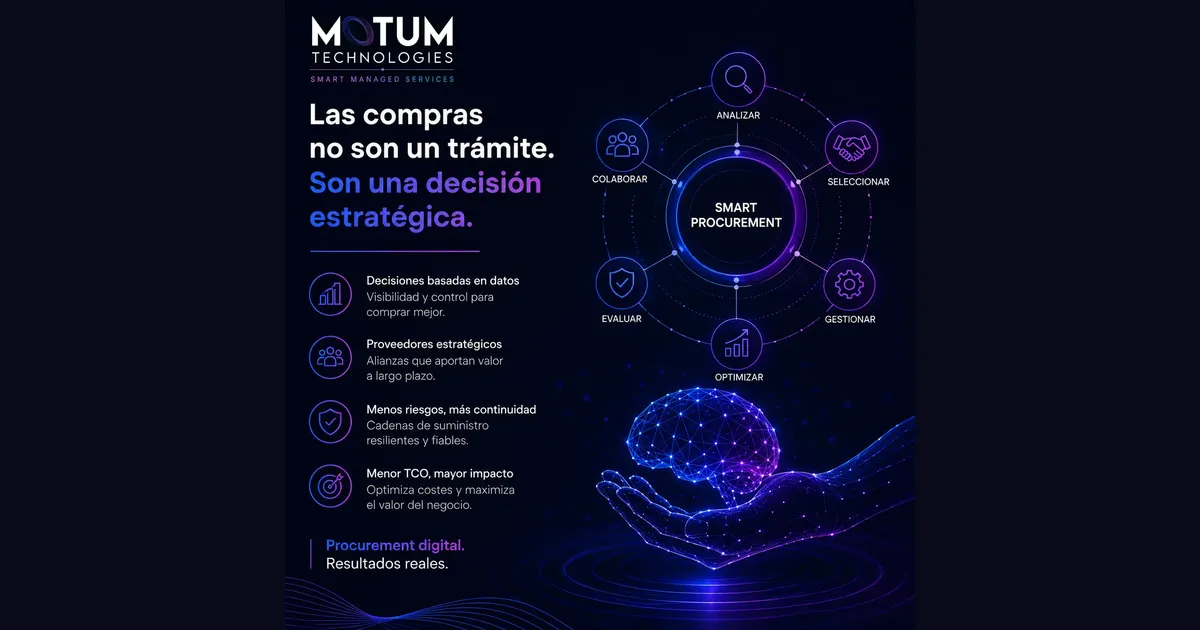 Motum Technologies ↗Why purchasing is a strategic area and not administrativeDescubre por qué la gestión de compras ha dejado de ser un proceso administrativo para convertirse en una función estratégica. Aprende cómo el procurement digital y el Smart Procurement ayudan a reducir costes, minimizar riesgos y acelerar la transformación tecnológica.
 Motum Technologies ↗The technological decisions that most impact EBITDADescubra qué decisiones tecnológicas mejoran el EBITDA de una empresa y cómo la infraestructura IT, la ciberseguridad, la automatización y los Smart Managed Services impulsan la rentabilidad.
 Motum Technologies ↗How to calculate the cost of a service outage Aprende a calcular el coste real de una caída de servicio, desde productividad y operación hasta recuperación, ventas y continuidad de negocio.
 Motum Technologies ↗Purchasing and Procurement Management — Motum TechnologiesServicios IT/OT desde Barcelona: ciberseguridad, conectividad, software a medida y soporte 24x7 para empresas en Cataluña, España y toda Europa.